

A flat city in the middle of a river plain, with a mountain range twenty-five minutes east and a wild dune coast half an hour west. The geography is the whole explanation: for the wind, for the cycling, and for how easy everything is to reach.
The shape of the place
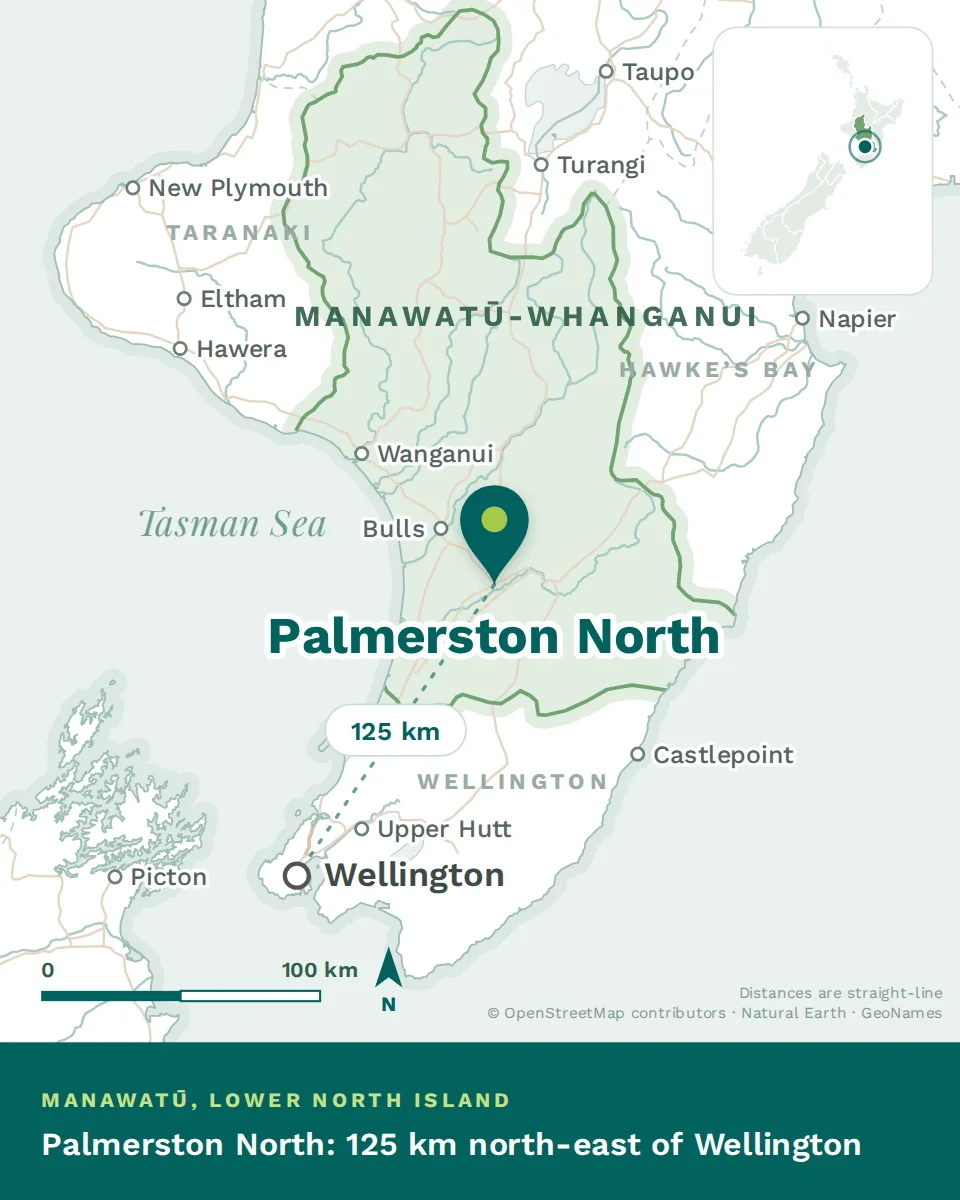
The Manawatū River comes down through the ranges and out across a wide alluvial plain to the Tasman. Palmerston North sits on that plain, just south of the river, laid out on a grid around a central square. There are almost no hills in the city; the only meaningful rise is on the southern edge towards Aokautere and Massey.
East, the Tararua and Ruahine ranges wall off the Wairarapa and Hawke’s Bay, split by the Manawatū Gorge — Te Āpiti. West, the plain runs out through Feilding and Foxton to a thirty-kilometre stretch of dunes and black-sand surf beach. North lie farmland and the Rangitīkei; south, Horowhenua and the road to Wellington.
Practically, this means everything is within about twenty-five minutes: the airport, the ranges, Feilding, the university, and every suburb in the city.
The four seasons
Indicative daytime highs. Nights are considerably cooler than the northern regions, and winter frosts are normal rather than notable.
What the numbers don’t tell you
The wind is the local signature. The Manawatū sits in a gap between two mountain ranges, which funnels the prevailing westerly straight across the plain. That is why there is a large wind farm on the hills above the gorge, and it is why the region is one of the windiest in the country. In practice: most days a breeze, a few days a year strong. People arriving from Wellington think it is calm.
Four real seasons, which the north does not get. Proper frosts, cold clear winter mornings, snow visible on the Tararua tops, and a distinct autumn. If you have come from northern Europe this will feel familiar and welcome. If you came for subtropical warmth, this is the wrong end of the island.
Cold houses, not damp ones. The regional housing problem here is heating rather than mould — older houses on a frosty plain. Ask about insulation, double glazing and a heat pump, and check the Healthy Homes compliance statement, which is a legal requirement and covered in the national Renting in New Zealand chapter.
It is drier than you would guess. Rainfall on the plain is moderate — noticeably less than Wellington, Auckland or the West Coast. The ranges take most of it.
Where things are, in driving time
Words you’ll hear
A flat, green, temperate city with distinct seasons, wind, and mountains and coast half an hour apart in opposite directions. The climate asks for a warm house rather than a dry one. What makes the place work is that nothing is far away — Where clinicians live is the next practical read.