
In healthcare, te reo Māori arrives with a Treaty relationship that shapes how care is designed, measured and delivered. You are asked to arrive willing, not expert.
 Kettle on. About 7 min
Te Tiriti o Waitangi, in practice
Signed in 1840 between Māori and the Crown, Te Tiriti is the founding agreement of the country. The history sits in About New Zealand — what matters on your first shift is what the Treaty relationship asks of you as a clinician. Every health regulator in New Zealand expects culturally safe practice, though each sets its own standards and assesses them in its own way; check your own board’s.
The three principles below are the familiar starting point, not the whole account. The Ministry of Health works from five: tino rangatiratanga (Māori self-determination), equity, active protection, options (including kaupapa Māori services) and partnership. The Ministry’s Te Tiriti framework sets them out.
Partnership
Working with Māori patients, whānau and communities rather than delivering to them. Decisions made together, and plans the whānau has agreed to.
In practiceThe person answering your questions may not be the person who decides. Ask who should be part of the conversation before you start, not after the plan is written.Participation
Māori involvement at every level — in their own care, and in how services are designed and run. Kaupapa Māori providers deliver care by Māori, for Māori, and you will refer to them and work alongside them.
In practiceIf a service is not reaching a group, that is treated as a service problem to solve — not a patient problem to record as non-attendance.Protection
Actively protecting Māori health and wellbeing, and closing outcome gaps that are well documented and long-standing.
In practiceEquity is not equality. Two people with the same diagnosis may need different amounts of your time, and giving it to them is the standard rather than favouritism.Improving health equity for Māori
One of the stated priorities of New Zealand healthcare is improving health outcomes and reducing inequities for Māori. Māori experience poorer outcomes across a range of health measures, alongside barriers to timely, appropriate care. Addressing that is a responsibility across the whole system, and it is the reason the Treaty principles above exist in health policy at all.
For a clinician arriving from overseas, the central idea is this: giving everyone the same care does not always produce equitable outcomes.
In practice it might mean:
- Recognising barriers such as transport, cost, language, or difficulty getting to appointments.
- Taking time to understand a patient’s circumstances, preferences and wider whānau needs.
- Working alongside Māori health professionals and kaupapa Māori services where appropriate.
- Reflecting on how your assumptions, communication and clinical decisions may shape the care a patient receives.
- Supporting care that is culturally safe, accessible and responsive to the person in front of you.
Nobody expects you to arrive knowing everything about Māori health. The expectation is that you arrive understanding why equity matters, willing to learn, and committed to care that works for the people receiving it.
Te Whare Tapa Whā
A Māori model of health you are likely to meet in your first week: wellbeing as a house standing on four walls, on the whenua beneath it. If one wall is weak the house is unstable — which is a more useful way to think about the person in front of you than a problem list is.
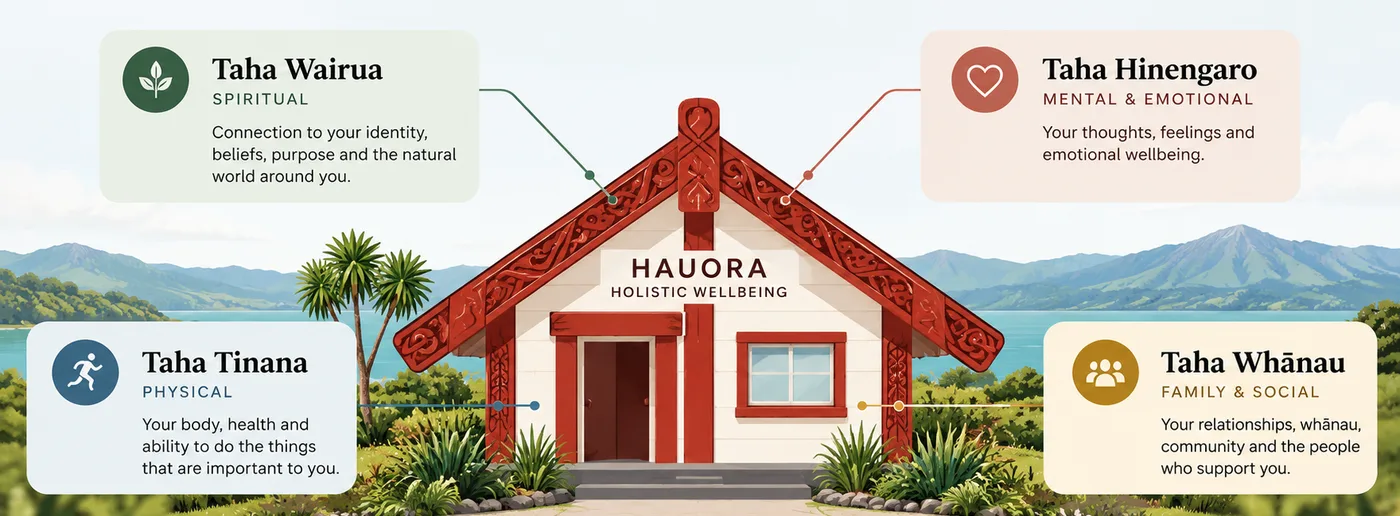
The body — pain, function, mobility, strength, nutrition. What most of us were trained to assess first.
Thoughts, feelings and mood. Rarely separable from a clinical outcome, and increasingly assessed alongside it.
Family and belonging. Who someone is caring for, and who is caring for them, is clinical information.
Purpose, identity and meaning — what the person is trying to get back to.
Connection to place and to whakapapa: the ground the four walls stand on. A person’s home, land and community are part of their health rather than the backdrop to it.
Used well this is not an extra form to complete. It is a prompt that a goal recorded as “increase shoulder range to 140°” may matter far less to the person than being able to lift a grandchild, or to stand and speak at a family gathering.
Cultural safety, plainly
Clinical competence is performing the technique correctly. Cultural safety is the patient’s judgement of whether your care was safe for them — which is why you cannot self-certify it, and why it is assessed as an ongoing competency rather than completed as an induction module.
It starts with you, not the patient: the Medical Council’s standard asks clinicians to reflect on their own attitudes, assumptions and biases, and on how their own culture shapes the care they give. Arriving from another health system, that reflection is the first piece of work. In day-to-day terms the rest is unremarkable good practice. Nobody expects fluency on arrival. People do notice effort.
- Learn to pronounce names, place names and the local iwi correctly — and ask if you are unsure.
- Ask who should be part of the conversation before you begin, rather than after the plan is written.
- Ask the patient whether they would like whānau involved in discussions and decisions, and respect their answer. Many will; some will not.
- Explain what you are about to do to someone’s body before you do it.
- Notice when someone has gone quiet, and do not read silence as agreement.
- Do not assume the patient is the decision-maker, or that they are not.
- Record goals in the person’s own words, not translated into clinical language.
- Accept correction without defending yourself. It is offered as help.
On a marae

You may be welcomed onto a marae for a service opening, a team day or a pōwhiri. You will be guided throughout and nothing is expected of you beyond following your host’s lead.
The short version
- Wait to be called on. Do not walk ahead of the group.
- Remove your shoes before entering the wharenui.
- No food or drink inside the wharenui, and do not sit on tables or pillows.
- Dress tidily and modestly; keep phones away and silent.
- A hongi — the pressing of noses and foreheads — is a greeting, not a kiss. Follow the lead offered to you.
- Koha is a contribution, usually collected by the group rather than by individuals.
- Speeches take the time they take. That is the point of them.
Go to the source
This guide is an introduction written by Ethicare. Your employer’s cultural safety training and local iwi guidance take precedence over anything here.
What all of this means inside your own discipline — the assessments, the goal-setting and the situations that catch overseas clinicians out — sits on your profession’s page. Find your profession
For the wider picture — the funders, the system priorities and what feels different across every profession — see practising in Aotearoa New Zealand.
Words you’ll hear
Everyday te reo Māori
Kiwi slang you’ll hear
Saying it right
- Vowels are pure and consistent: a = "ah", e = "eh", i = "ee", o = "aw", u = "oo" — every time.
- "Wh" sounds like "f" — so whānau is "fah-now".
- "R" is lightly rolled, closer to a soft "d" than an English r.
- Macrons (ā ē ī ō ū) simply lengthen the vowel — Māori is "Maa-ori".
- Place names reward a go: Taupō is "Toe-paw", Whangārei is "Fong-ah-ray". Locals value the effort far more than perfection.
Ethicare Resourcing
This chapter is part of a bigger guide — and we’re here for the rest of it
We place healthcare professionals across New Zealand and Australia, and stay with the move through registration, visas and the first months after you land.