
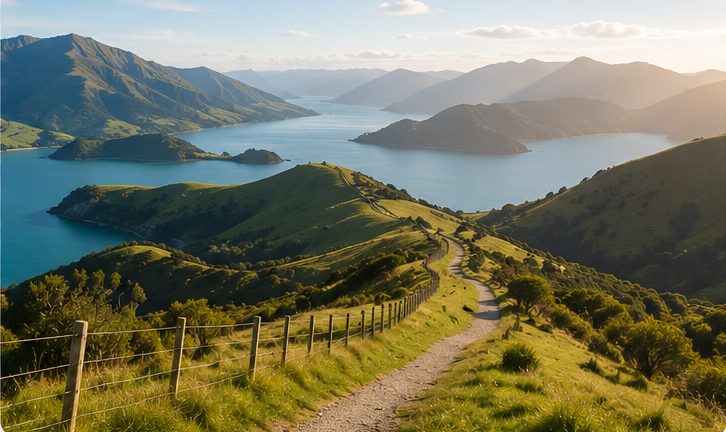
Aotearoa, the land of the long white cloud
Getting to know New Zealand
Before it’s a job or a visa, it’s a place: its own land, its own history, its own way of doing things. Start here.
 Kettle on. About 9 min
A small country with a big heart
Aotearoa is a nation of around five million people at the bottom of the South Pacific, closer to Antarctica than to most of the world.
What strikes most newcomers first is the contrast between the dramatic and the gentle. Soaring mountains, deep fiords and wild coastlines sit beside an unhurried, friendly way of life. People are direct but warm, proud but unshowy, and quick to make room for you. Underpinning it all is a bicultural foundation, the partnership between Māori, the indigenous people, and those who came later, layered today with communities from every corner of the world.
You don’t need to know any of this before you arrive, but a little understanding goes a long way. The people who settle most happily are those who come curious, ready to learn the land’s stories and customs rather than expecting it to be just like home.
Two islands, and never far from nature
New Zealand stretches long and narrow, so wherever you settle the coast, the bush and the mountains are close.
The North Island
Warmer and more populous, home to Auckland and the capital, Wellington. Rolling green farmland, volcanic plateaus, geothermal Rotorua and long surf beaches define it.
The South Island
Wilder and more spacious, with the Southern Alps running down its spine, the lakes and fiords of the south, and Christchurch and Dunedin as its main cities.
Temperate & seasonal
Mild rather than extreme, with four real seasons, and reversed from the northern hemisphere. Summer is December to February; the far south can be properly cold in winter.
How Aotearoa came to be
New Zealand was one of the last large landmasses on earth to be settled by people.
Māori settlement
Polynesian voyagers navigated vast distances of open ocean to reach Aotearoa, becoming the tāngata whenua, the people of the land, and developing distinct iwi (tribes) with rich language, custom and oral history.
First European contact
Dutch explorer Abel Tasman sighted the coast in 1642; more than a century later, British navigator James Cook mapped the islands, opening the way to wider European contact and trade.
Te Tiriti o Waitangi
The Treaty of Waitangi was signed between the British Crown and many Māori rangatira (chiefs), the document still considered New Zealand’s founding agreement, and central to public life to this day.
Colonisation & conflict
Rapid settlement, the New Zealand Wars and large-scale land loss profoundly affected Māori, a difficult history the country continues to reckon with and openly.
Votes for women
New Zealand became the first self-governing country in the world to grant women the right to vote, an early mark of the egalitarian streak it still prizes.
Renaissance & a modern nation
A Māori cultural renaissance revitalised te reo and tikanga, Treaty settlements began addressing historic wrongs, and waves of migration made New Zealand the diverse, outward-looking democracy it is now.
Te Tiriti o Waitangi
Signed on 6 February 1840, Te Tiriti o Waitangi is an agreement between the Crown and Māori. It shapes law, public services and the health system you’ll work in.
Kāwanatanga
Governance, the Crown’s role in governing the country, establishing settled law and order.
Rangatiratanga
Chieftainship: Māori authority over their lands, resources and taonga (treasures), including language and custom.
Ōritetanga
Equity, the same rights, protections and citizenship for Māori as for all New Zealanders.
The English and te reo Māori texts differ in important ways, and those differences sit at the heart of New Zealand’s ongoing conversation about partnership. For healthcare workers this matters in practice: the principles of Te Tiriti underpin the health system’s commitment to equity and to better outcomes for Māori, something you’ll see reflected in how care is delivered.
A few words you’ll hear every day
Te reo Māori is an official language, woven through greetings, place names, signage and the workplace. No one expects fluency.
Place names are often te reo too, so it’s worth learning to say where you live correctly. Locals will warmly help you. Pronunciation is consistent once you learn the vowels, and getting it right is appreciated.
What New Zealanders are like
Welcoming
Hospitality runs deep. Neighbours, colleagues and other families who’ve made the move tend to fold you in quickly: many newcomers are surprised how at home they feel within months.
A love of the outdoors
Weekends are for the beach, the bush, the boat or the rugby. Connection to the land is central, and an easy, shared way to make friends and feel you belong.
Egalitarian & informal
Hierarchy is downplayed and first names are the norm, even at work. People value humility, fairness and pitching in, the “number eight wire” knack for practical problem-solving is a point of pride.
Diverse & multicultural
Alongside its bicultural foundation, New Zealand is home to large Pacific, Asian, South African, British and many other communities, so you’ll rarely be the only one who has come from somewhere else.
A note on the everyday
Life here is comfortable and modern but a little more low-key than some are used to: shops close earlier, cities are smaller, and the pace is gentler. For most people that’s precisely the appeal. The trade is a simpler, more spacious kind of life, and it’s one our clinicians rarely regret.

When my own family arrived, the thing that moved me most wasn’t the scenery, it was how readily people made space for us. Learn a few words of te reo, say yes to the invitation to the beach, ask people how to pronounce their town’s name properly. None of it is hard, and all of it tells New Zealand you’ve come to belong, not just to work. That openness, more than anything, is what turns a posting into a home.
SophieFounder, Ethicare Resourcing
The things people ask us first
Do I need to speak te reo Māori?
Not at all. English is the everyday working language, and you’ll get by perfectly without a word of te reo. That said, learning a handful of common greetings and saying place names correctly is warmly received, and it’s a lovely, easy way to show you respect where you’ve come to live. You’ll absorb plenty just by being here.
Why does the Treaty matter for my work in healthcare?
Te Tiriti o Waitangi underpins how public services, including health, are designed and delivered. In practice that means the system places real emphasis on equity and on improving outcomes for Māori, and you’ll see that reflected in policy, training and day-to-day care. You don’t need to be an expert, an open, respectful willingness to understand it is exactly what’s hoped for.
Is New Zealand very different culturally from home?
It depends where you’re coming from, but most newcomers find it familiar enough to settle quickly and different enough to feel new. It’s a modern, English-speaking democracy with a relaxed, outdoorsy, egalitarian culture and a strong bicultural heart. The adjustments tend to be gentle: a slower pace, smaller cities, earlier nights.
Will my family fit in?
Most families settle well, though it takes time. New Zealand is welcoming and diverse, and there are well-established communities from all over the world. Children in particular settle fast, helped by friendly schools and an outdoor childhood. Our community guide lists groups you can join before you arrive.
Related guides
Curious about life in New Zealand?
Whether you’re weighing up the move or want to understand the country better, we’re always glad to talk about the land, the lifestyle, and whether it could be the right home for your family.
Ethicare Resourcing · your guide to a life and career in New Zealand.