

Southland is a broad, intensely green plain, bounded by mountains to the north-west and a wild ocean to the south. Nothing about it is dramatic until you reach the edges — and then it is as dramatic as anywhere on earth.
The shape of the region
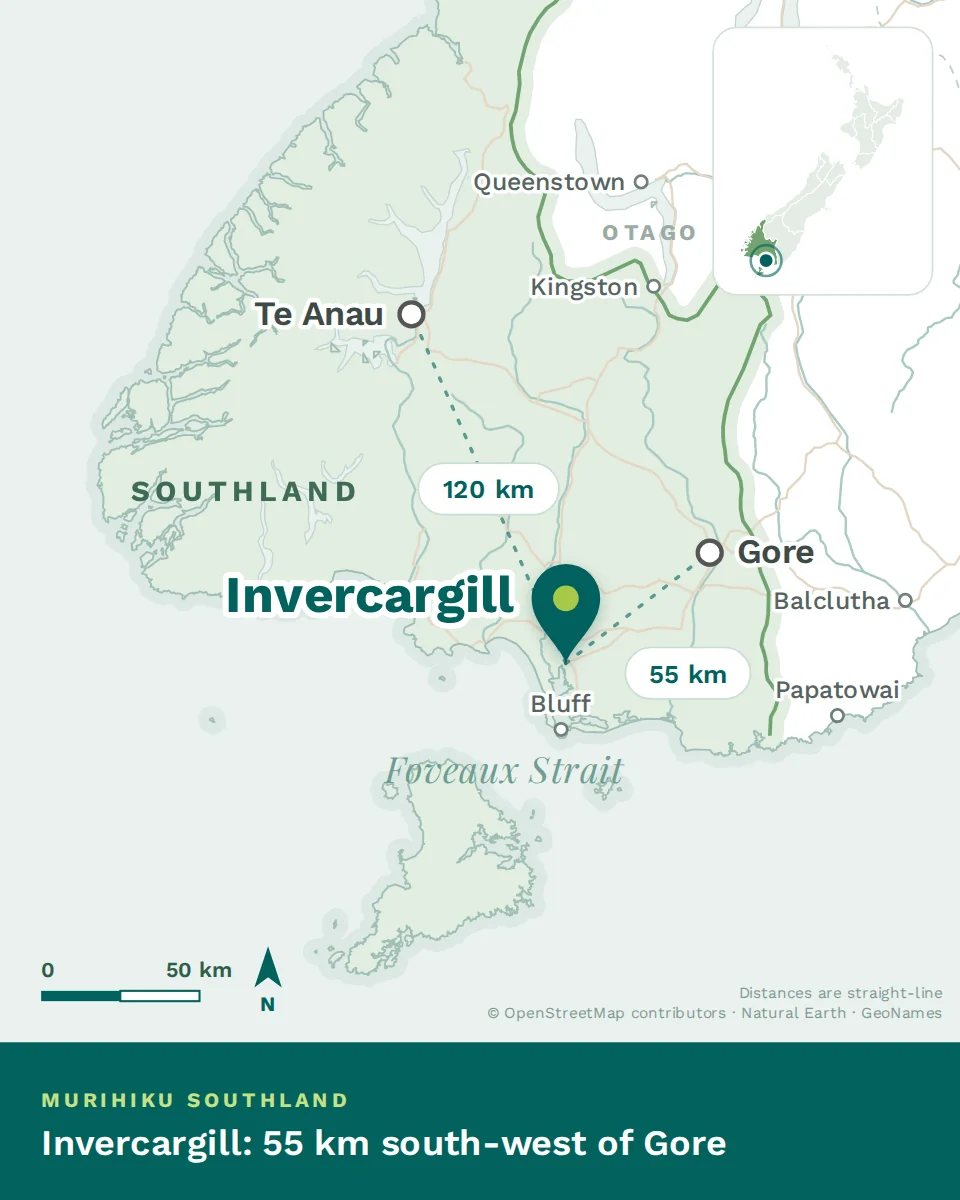
The middle of Southland is farmland: the Southland Plains, some of the most productive pasture in the country, running from the Takitimu Mountains down to the sea. Invercargill sits near the southern edge on the Waihōpai River, with the Oreti and New River estuaries beside it and Oreti Beach’s long grey sweep to the west.
North-east through the plains is Gore, an hour away, on the Mataura River — a farming and brown-trout town, and the region’s second centre. North-west, past Winton and Lumsden, the land climbs into the Te Anau basin and then into Fiordland: 1.2 million hectares of World Heritage wilderness, glacial sounds, and some of the highest rainfall on the planet.
South of the city, Bluff sits on its hill above the strait, and an hour by ferry beyond it is Rakiura — Stewart Island — eighty-five per cent national park, four hundred people, and one of the best places in the world to see kiwi in the wild. East, the coast runs into the Catlins.
The four seasons
Indicative daytime highs. Snow at sea level is uncommon; frost is normal. Inland around Gore and Te Anau the range is wider at both ends.
What the numbers don’t tell you
The light is the thing nobody warns you about. At 46 degrees south the summer days are enormous — light from before five in the morning until nearly ten at night around the solstice. It reshapes how you live for four months of the year. The corollary is a dark midwinter, and it is fair to weigh both.
It is cool rather than cold. Southland’s reputation is for grimness, but the maritime climate keeps extremes off: it rarely freezes hard and rarely gets hot. What it does do is change quickly, and blow. Locals dress for four seasons in a day and think nothing of it.
The wind is constant, and spring is the worst of it. A prevailing westerly straight off the Southern Ocean with nothing between here and Antarctica. You will own a good coat within a fortnight.
Houses need to be warm, and increasingly are. The regional housing challenge is heating and damp together. Because homes are cheap here you can afford to buy one that is already well insulated — a clear advantage over the expensive regions. Check the Healthy Homes compliance statement, which is a legal requirement and covered in the national Renting in New Zealand chapter.
The aurora australis is real and it is visible. On clear, geomagnetically active nights the southern lights appear over the southern horizon. There are local groups who chase it. Very few inhabited places on earth offer this from the back garden.
Where things are, in driving time
Words you’ll hear
A green farming plain with Fiordland at one end and the Southern Ocean at the other. The climate is cool, changeable and windy — that is the cost, and it is why the housing is the cheapest in the country. In return you get summer evenings that last until ten and wilderness most people see once in a lifetime. Where clinicians live is next.