
New South Wales runs from subtropical banana country to alpine snow gums in one state. Three bands explain all of it: the coast, the range, and the plains beyond — and which band you live in decides your climate, your commute and your rent.
The three bands
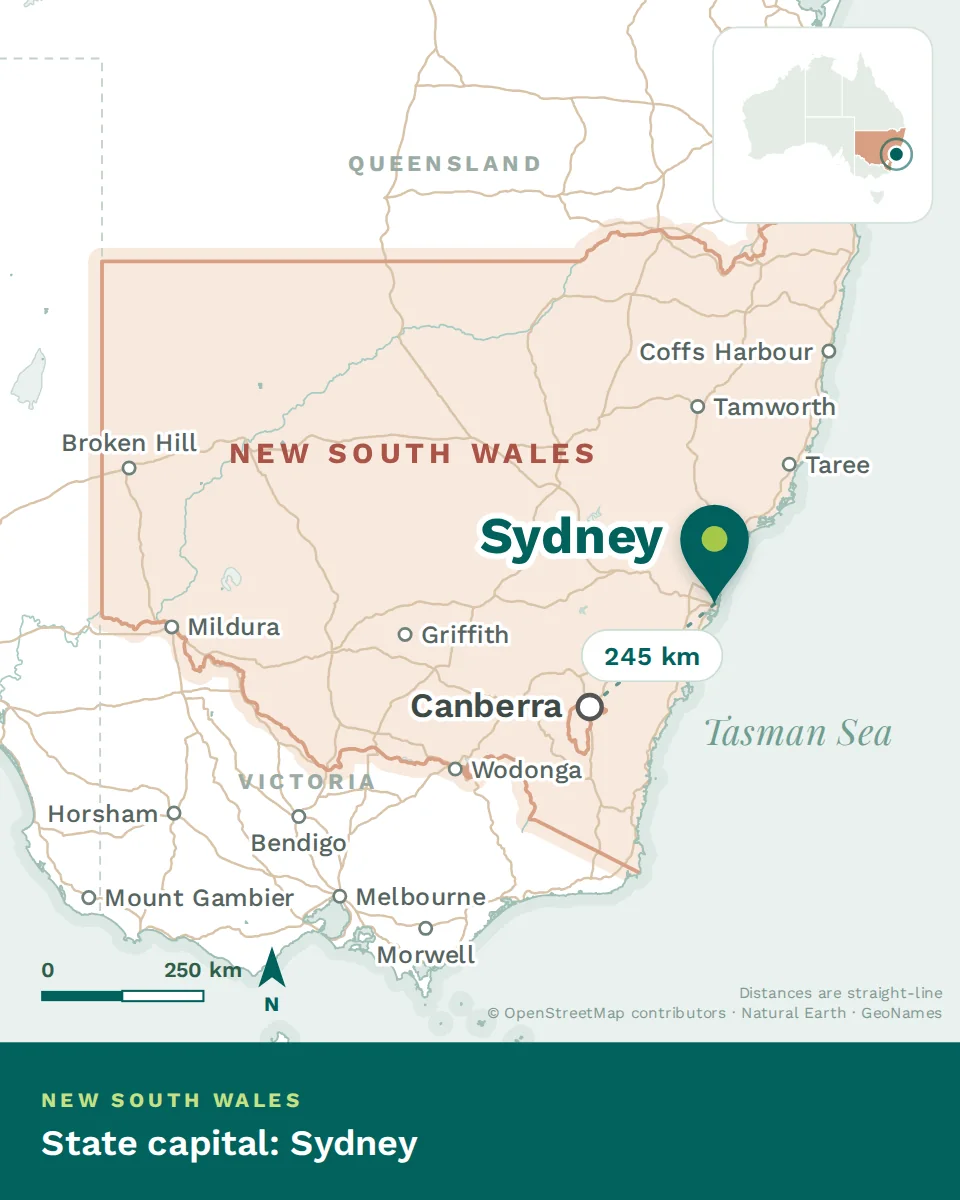
The coast is where almost everyone lives: a green strip between the Pacific and the escarpment, holding Sydney, Newcastle, Wollongong and the string of coastal towns. Warm humid summers, mild winters, and the surf culture that shapes everyday life.
The range — the Great Dividing Range — runs the length of the state a little inland: the Blue Mountains behind Sydney, the New England tablelands in the north, the Southern Highlands and, at the very south, the Snowy Mountains, where Australia skis. Cooler, frostier, four-seasoned.
The plains beyond are the wheat, sheep and canola country of the Riverina and the central west, thinning to the red outback around Broken Hill. Hot dry summers, cold clear winters, and the rural medicine that goes with real distance.
The four seasons, on the coast
Indicative Sydney daytime highs. The Northern Rivers run warmer and stickier; the tablelands and Riverina add frost in winter and real heat in summer.
What the numbers don’t tell you
Summer is lived outdoors and planned around heat. Beach before work, shade at midday, and a bushfire season in the hot months — well-managed, well-communicated, and part of life rather than a reason not to come. Sign up to the emergency apps and take the local advice seriously.
Winter indoors is the surprise. Australian coastal houses are built for summer: eighteen degrees outside can mean sixteen in the lounge. Ask about heating and insulation when you rent — the national Living in Australia chapter covers what to check.
Rain arrives in bursts. The east coast gets proper storm systems — weeks of sun, then a fortnight’s rain in a weekend, with flooding in the usual valleys. Locals know their creeks; you will too.
The UV is serious everywhere. Higher than the temperature suggests, all year. Slip-slop-slap isn’t a slogan for tourists; the melanoma statistics are why every clinician here nags about it.
Where things are, in travel time
Words you’ll hear
One state, three climates: humid coast, four-season range, hot dry plains. Almost everyone lives on the coast band, and which hundred kilometres of it you pick matters more than the state itself — Where clinicians live is next.