
Melbourne is the choice for clinicians who want the system, not the beach. Australia’s deepest concentration of tertiary and quaternary medicine, the country’s largest medical research precinct, and a city built on trams, laneways and an argument about coffee. It asks you to accept the weather.
A city that rewards people who like cities
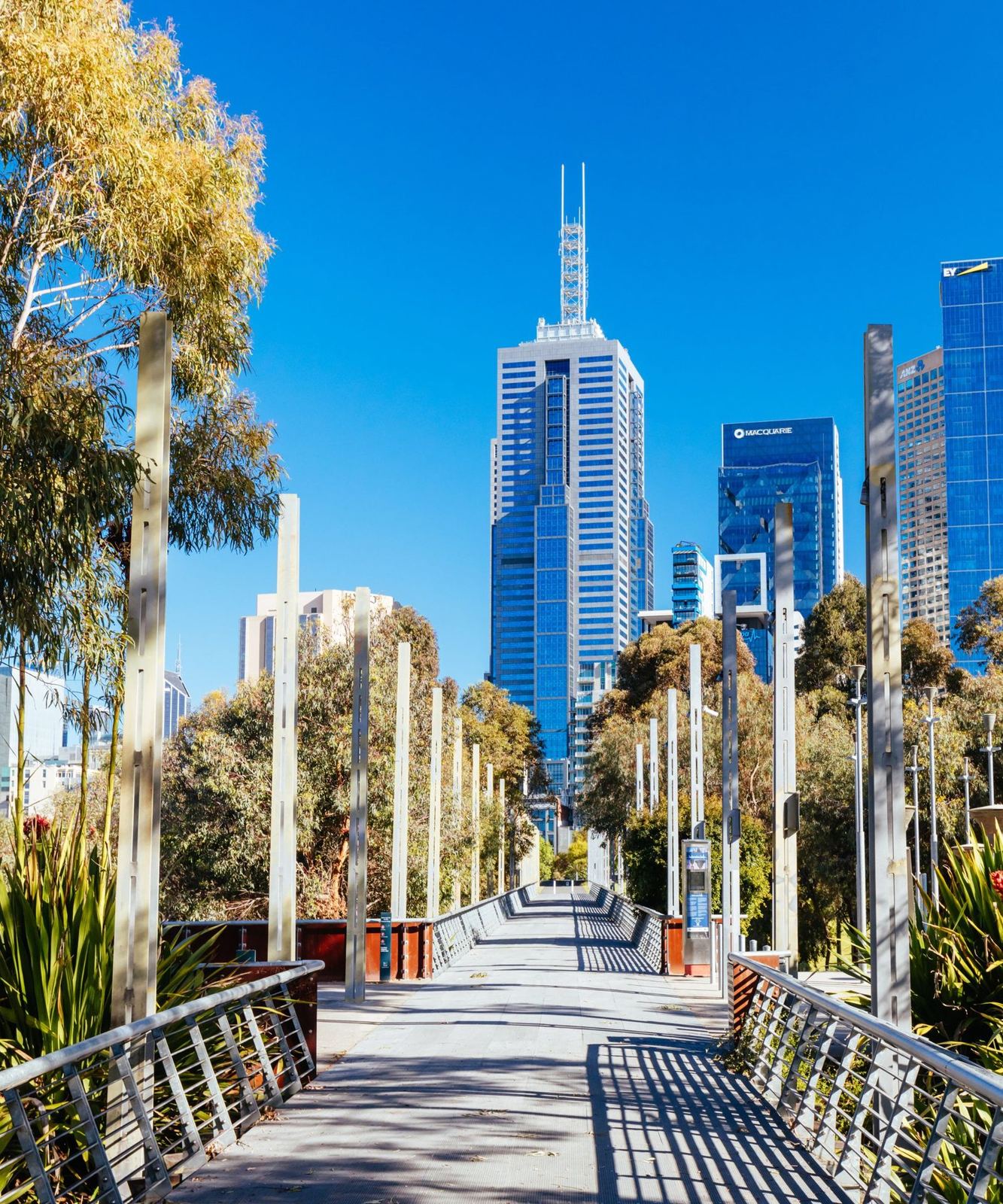
Around five million people live here, spread across a grid that Hoddle laid out in 1837 and a tram network that never got torn up — the largest in the world. The centre is dense and walkable, wrapped in gardens, and ringed by inner suburbs of Victorian terraces: Carlton, Fitzroy, Brunswick, Richmond, South Melbourne. Beyond them the city runs out to Port Phillip Bay in one direction and the Dandenong Ranges in the other.
For clinicians the draw is depth. Melbourne carries more tertiary and quaternary services than any other Australian city, an internationally significant biomedical research precinct clustered around them, and specialist centres that take referrals from across the country. If your sub-specialty is narrow, or you want research alongside clinical work, this is the strongest market in Australia.
The costs are the weather and the price. Four seasons in a day is not a joke: a July morning can be cold and a February afternoon dangerous. And Melbourne is expensive — less brutal than Sydney, well above Brisbane or Adelaide — so the housing arithmetic needs doing carefully before you commit.
- Ethicare is a healthcare recruitment company. This guide is free to read, asks nothing of you, and does not give visa advice.
- Melbourne is where we send clinicians who want the deepest system and the richest city life, and it is the city where the housing sums matter most. Where we think somewhere else fits you better, we say so.
The city, in nine numbers
Six things you only learn once you’re here
- Melbourne stands on the lands of the Wurundjeri Woi Wurrung and Boon Wurrung peoples of the Kulin Nation, and Naarm is the name you will see used widely alongside Melbourne, including by health services.
- Acknowledgement of Country opens meetings, and Victoria’s treaty and truth-telling processes are further advanced than any other state’s — so this is live, current context, not history. Take the cultural induction seriously.
How to read this guide
Nine chapters, all about Melbourne specifically. Topics that are true across the state — regional Victoria, the state health structure — sit in the Victoria guide. Anything true of Australia generally — Medicare, visas, Ahpra registration, tax, superannuation, schools — lives once in Moving to Australia.
If you read nothing else, read Why Melbourne for the full case — and what we’d ask you to weigh, and Where clinicians live, because in a city this size the tram line decides the life.