
Before the practical chapters, orientation. Melbourne is unusually legible for a city of five million: a grid at the centre, rings of suburbs around it, and a tram network that makes the whole inner city navigable within a week of arriving.
How the city is laid out
The grid and the river
The centre is the Hoddle Grid, laid out in 1837 and still doing its job: numbered blocks, main streets with laneways behind them, and the Yarra along the southern edge. Southbank and Docklands extend it across and down the river; the gardens ring it on three sides. Most of the tertiary hospital work sits either inside this ring or immediately north and east of it.
The inner rings
North: Carlton, Fitzroy, Brunswick and Northcote — terraces, students, live music and the best of the food. East: Richmond, Hawthorn and Kew, leafier and dearer as you go. South: South Melbourne, Albert Park, St Kilda and Prahran, with the bay at the bottom. West: Footscray, Yarraville and Williamstown, the fastest-changing part of the city and still the best value inside ten kilometres.
The outer city
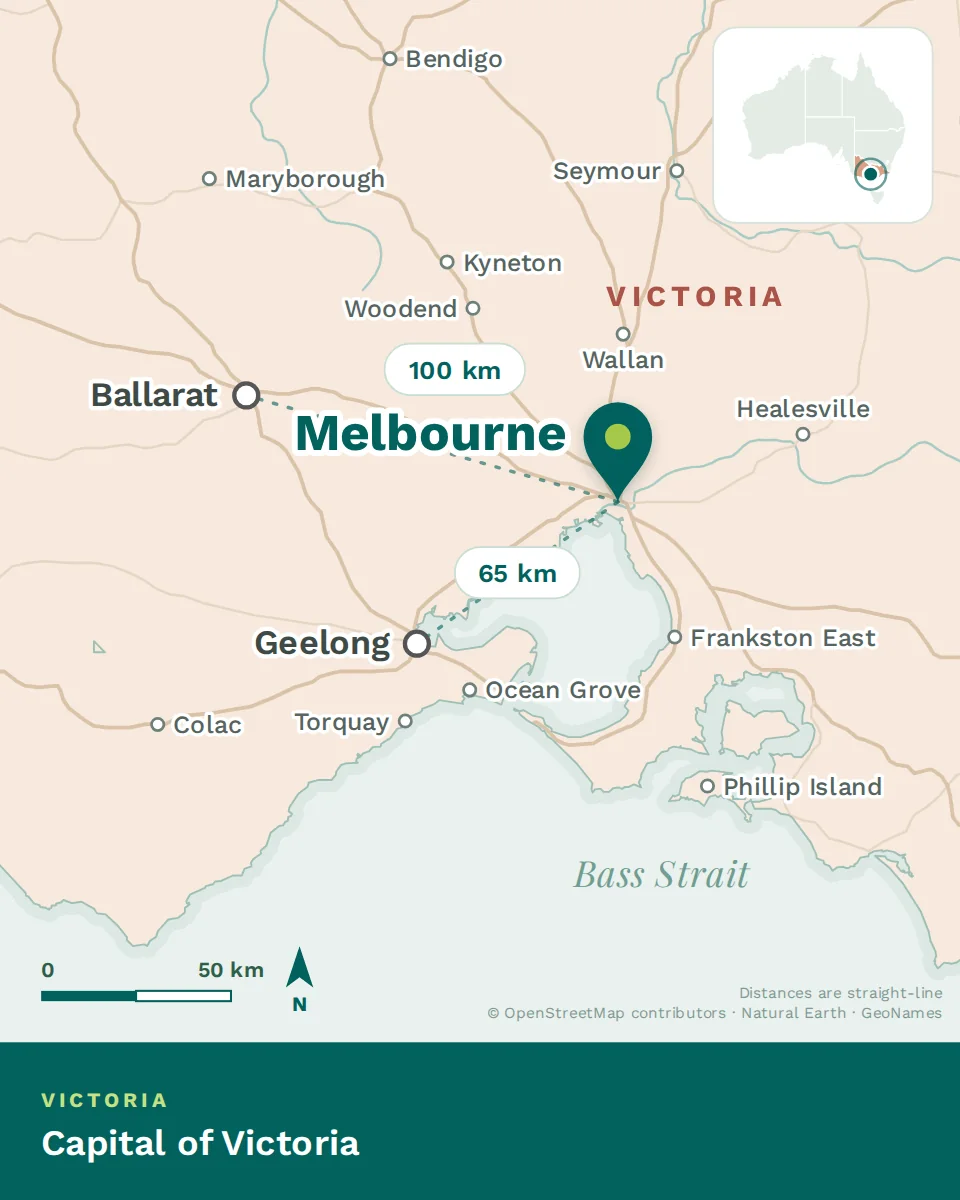
Beyond about fifteen kilometres, Melbourne becomes a different proposition: large growth corridors north, west and south-east, newer housing, bigger blocks, longer commutes and their own regional hospitals. The bay curls south to the Mornington Peninsula; the Dandenong Ranges rise to the east; and Geelong sits an hour south-west as a city in its own right.
Four seasons in a day
The cliché is accurate, and it comes from geography: cold fronts arrive off the Southern Ocean and cross the city in an hour. Summer brings serious heat — a run of 40-degree days most years, with total fire ban days across the state — and winter is cool, grey and damp rather than freezing, with dark mornings. Spring and autumn are the best of it, and unpredictable.
Two practical notes. Heating matters here in a way it does not further north — ask what a rental has, because older terraces and weatherboards can be cold and expensive to run. And take fire-danger days seriously if you live on the city’s fringe or plan weekends in the ranges: the warnings are precise and worth obeying.
Getting in and out
Melbourne Airport is about half an hour north-west of the city, with direct flights across Asia, the Middle East and the Pacific and constant shuttles to Sydney — one of the busiest air routes in the world. There is no train to the terminals yet, so budget for a bus or a taxi. Overland, Geelong is an hour, the Great Ocean Road starts ninety minutes away, Sydney is a full day’s drive or a 90-minute flight, and the overnight ferry to Tasmania sails from Geelong.