

Everywhere else in New Zealand has a maritime climate: mild, damp, moderated by the sea. Central Otago does not. Ringed by mountains that strip the weather of its rain, it is the one continental corner of the country — and it feels like a different nation.
The shape of the region
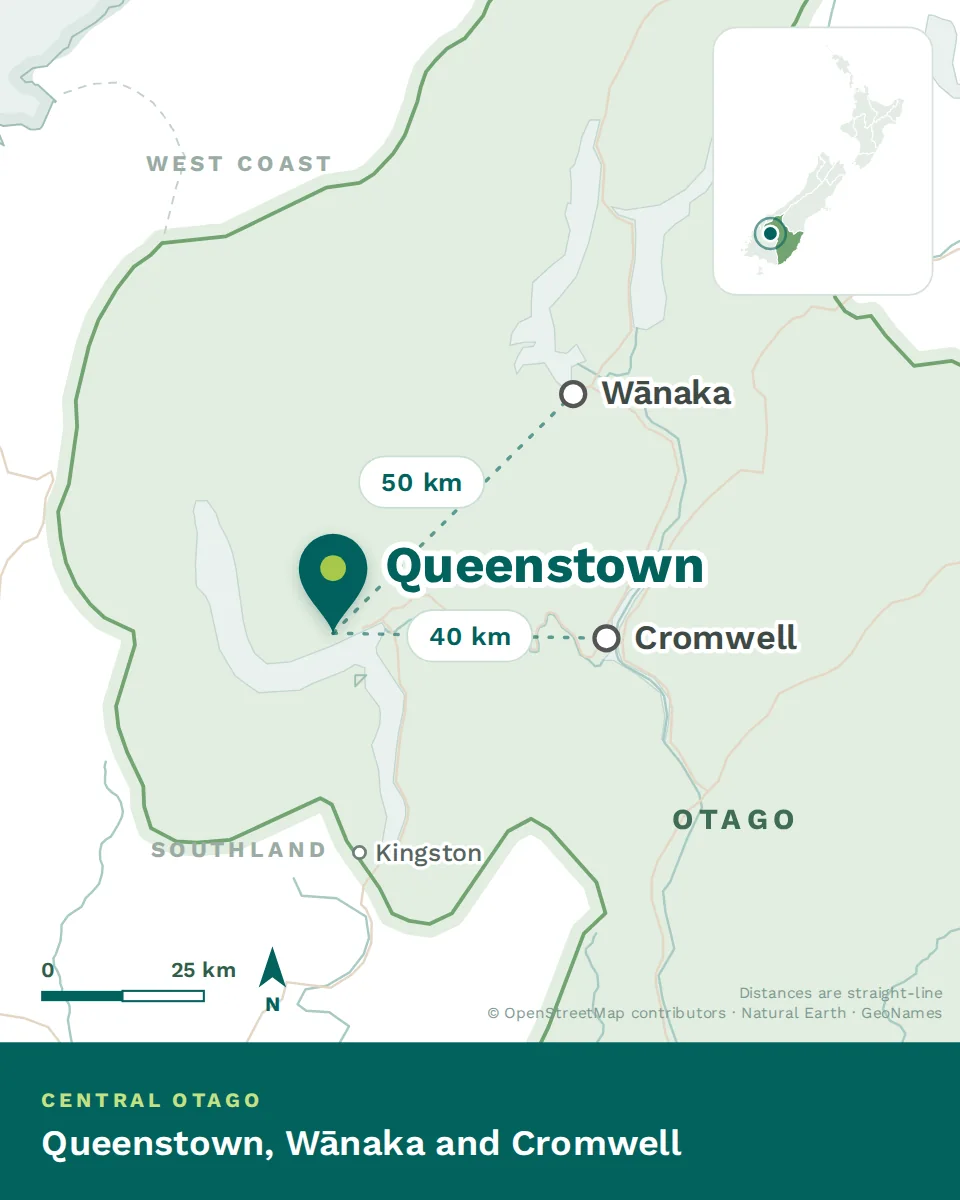
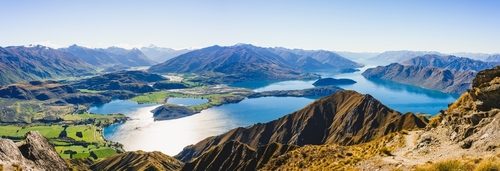
Think of it as two halves. The lakes sit in the west, where glaciers gouged deep troughs into the Southern Alps: Wakatipu with Queenstown on its edge, Wānaka and Hāwea to the north, the Remarkables and Mt Aspiring National Park behind. It is steep, dramatic country, wetter and greener.
East of the Kawarau Gorge, the land opens into the basins — Cromwell, Alexandra, Clyde, and the Maniototo beyond. Rounded schist hills, thyme and wild rose, orchards and vineyards on the valley floors, and the Clutha River running through. This is the dry interior: brown in summer, gold in autumn, frozen and often fog-bound in winter.
Practically: Queenstown to Wānaka is an hour over the Crown Range or ninety minutes the long way. Queenstown to Cromwell is forty-five minutes. Dunedin is three hours, Invercargill a little over two, Christchurch six.
The four seasons
Indicative. Inland around Alexandra and Clyde the extremes are sharper at both ends than in the lakes.
What the numbers don’t tell you
It is the driest place in New Zealand. The Alexandra basin gets somewhere around 350 to 450 millimetres of rain a year — semi-arid, less than parts of Spain. Irrigation is what makes the orchards and vineyards possible. If you have spent years under grey drizzle, the sheer quantity of clear sky here is the thing that changes your mood.
The autumn is worth planning your year around. Poplars and willows through the gorges and around the lakes turn every shade from lemon to rust, against brown hills and blue water. People travel across the world for it. You will get it from your kitchen window.
Winter is cold, clear and occasionally strange. Hard frosts, real snow, and temperature inversions that trap freezing fog in the inland basins for days at a time while the tops above sit in sunshine. Locals drive up out of it. It is beautiful, and it takes adjusting to.
The houses are better than the national average. Because they have to be. Insulation, double glazing and log burners are normal here in a way they are not in the warmer north. Still check the Healthy Homes compliance statement, which is a legal requirement and covered in the national Renting in New Zealand chapter.
Summer is hot and the UV is fierce. Thirty degrees and a thin atmosphere at altitude. Sunburn happens in twenty minutes. Everyone here is careful about it and you will become so too.
Where things are, in driving time
Words you’ll hear
The one part of New Zealand with a true continental climate — hot dry summers, hard frosts, real snow, and an autumn people travel the world for. Two regions in one: the lakes to the west, the dry basins to the east. Which you choose decides your rent, your commute and your winter — Where clinicians live is next.