

The shape of the city, who arrived when, what fills the calendar, and how people get about — the orientation that makes your first week easier.
A city on a narrow waist of land
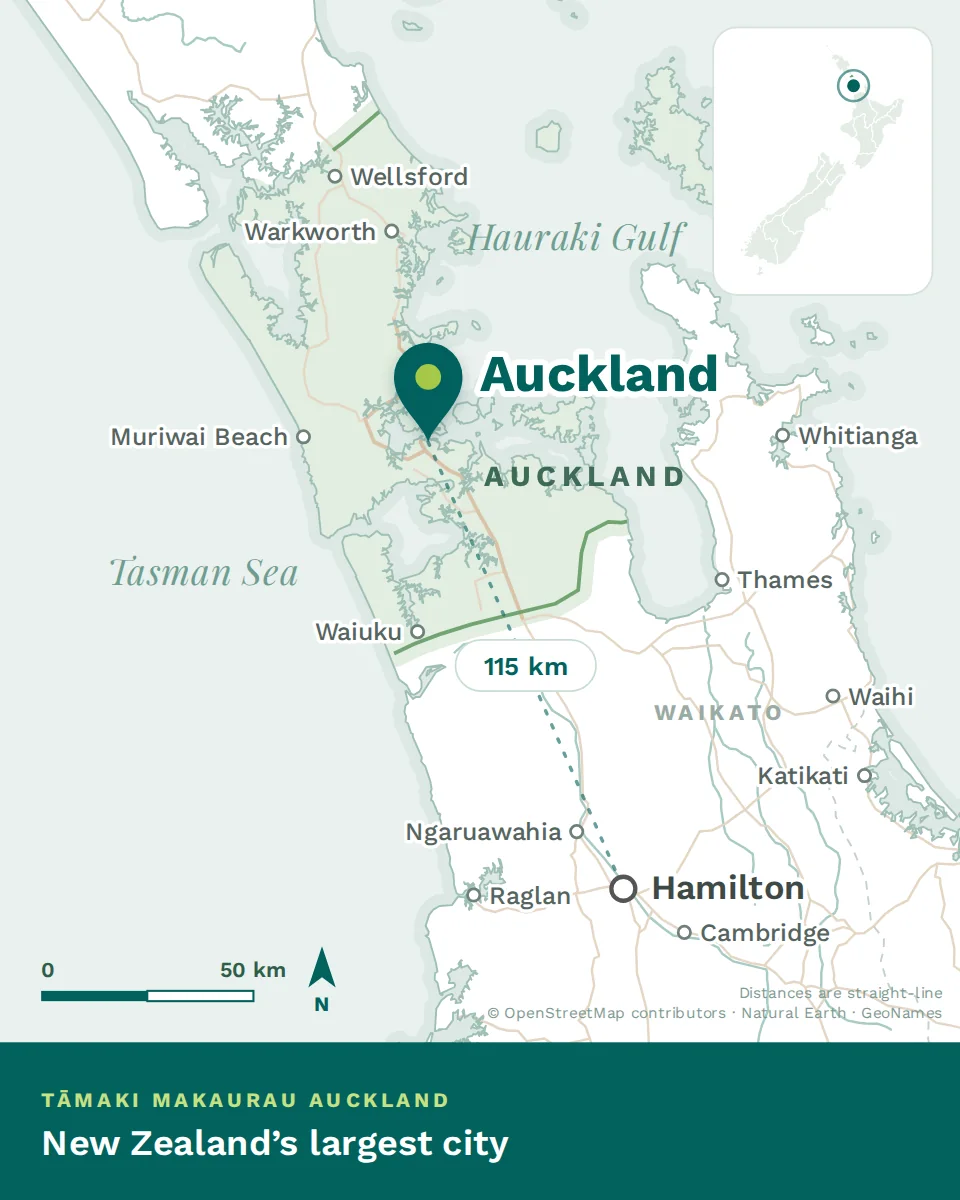
Auckland sits on an isthmus barely two kilometres across at its narrowest — the Waitematā Harbour on one side, the Manukau on the other. Understanding that shape explains almost everything about commuting here. Select a place to see where it sits.
A schematic — not to scale, and not a map for navigating by.
Built on volcanoes
The volcanic field beneath Auckland has erupted around fifty times over the last 200,000 years, and each eruption left a cone, a crater or a lava flow. What that means today is a city interrupted, pleasantly, by hills — most of them public parks.
Māori built fortified pā on the largest of them. Maungawhau (Mount Eden), Maungakiekie (One Tree Hill) and Takarunga (Mount Victoria) still carry the terracing, and the views from the top are the quickest way to understand how the city fits together. Rangitoto, the youngest cone, rose from the sea only about 600 years ago and was watched from shore as it formed.
Practically speaking, it means most suburbs have a hill you can walk up before work, and that the flat run between them is where the motorways went.
How the city became this mixed
You will not be the first person to arrive here from a long way away. That is the single most useful thing to know about Auckland.
Four weekends worth putting in your diary
Dates shift year to year, so check before you plan — but these four are the ones people talk about.
Four ways people move about
Auckland Transport runs the buses, trains and ferries under one fare system. Get an AT HOP card in your first week — it’s cheaper than paying cash and works on everything.
The full detail — licences, buying a car, running costs and the traffic — is in Getting around.
The rhythm of the year
Auckland’s climate is mild — no snow, no extremes, and you can swim from December to April. What catches people is the rhythm rather than the weather: when the country works, when it stops, when flights cost double, and why a fourteen-degree winter can feel colder than a British one.
The year, in four parts
Averages for the city, so treat them as the shape rather than a forecast. Auckland’s real signature is variability — four seasons in a day is a cliché because it’s accurate.
Sea temperature peaks in February rather than January — the water lags the air by about a month. Summer daylight runs until around nine, which is what makes an after-shift swim practical.
For about a month, the country closes
From a few days before Christmas until well into January, New Zealand stops. Not slows — stops. Trades go away, offices run on skeleton staff, businesses close for two or three weeks with a note on the door, and the whole country appears to be at a beach somewhere.
This is lovely if you’re on holiday and difficult if you’ve just arrived. It’s the single most important thing in this chapter for anyone choosing a start date.
- February or late March are the easiest months to land in. Everything is open, the weather is still excellent, school has started so the rental market has settled, and you get four good months before winter.
- October is the next best. Mid-December is the hardest — you’ll arrive to closed offices, no trades available and a rental market that has gone quiet.
Fourteen degrees outside can feel colder than four
This is the complaint you’ll hear from every British, Irish and Northern European arrival, and it isn’t imagined. Auckland winters are mild by any measure — daytime highs around fourteen, frost almost unheard of, no snow. But the older housing stock was built for a warm climate on the assumption that nobody would need central heating, and a great many houses are single-glazed, under-insulated and unheated in the rooms you’re not sitting in.
Add humidity. Auckland is damp, and a damp fourteen degrees inside a still room is unpleasant in a way a dry four degrees with a radiator is not. The consequence people are least prepared for is mould — on window reveals, in wardrobes, behind furniture against an external wall.
The Healthy Homes standards have improved rentals substantially, and a modern or well-renovated house is entirely comfortable. But the habits are different from what you’re used to, and they’re learnable in a week.
- Open windows for ten minutes every morning, even in winter. Moving air is what stops mould, not heat.
- A dehumidifier is standard equipment here, not a luxury. Run it overnight in the wettest rooms.
- Dry washing outside or in a vented dryer, never on a rack in a closed bedroom.
- Heat the room you’re in, and shut the door. Whole-house heating is rare and expensive.
- Pull furniture a few centimetres off external walls so air can move behind it.
The five Healthy Homes standards a rental must meet, and what to look for at a viewing, are set out in the Moving to New Zealand guide.
The school year runs with the calendar year, not across it
Four terms, starting in late January or early February and finishing in mid-December, with two-week breaks between and six weeks over summer. If you’re moving children mid-year, this is the detail that reshapes your timing.
Timing the trip back is worth real money
Long-haul fares from New Zealand swing enormously with the season, and the expensive windows are predictable. Getting this right once a year is worth more than most of the savings in Cost of living.
- Twenty-four hours of flying each way makes a ten-day visit hard on everybody.
- Most people here take three or four weeks and go once every year or two.
- Build the annual-leave request in early — hospital rosters fill months ahead.
Bring layers and rain gear, not thickness
The single most common packing mistake is a heavy winter coat that never comes out of the wardrobe, and no waterproof jacket.
“The first Christmas is the strange one. Thirty degrees, a barbecue, everyone at the beach, and light until nine at night — and somewhere underneath it a small part of you expecting dark afternoons and the smell of a kitchen at home. Plan for it rather than being surprised by it. Ring people at their Christmas Eve, not yours. And then go swimming on Christmas morning, because by the second year that is the bit you would not give up.”