
Before the practical chapters, orientation. Tasmania is compact — Ireland-sized, two and a half hours end to end — but it divides, for a newcomer’s purposes, into three quite different places sharing one cool-temperate climate and a ferry line to the mainland.
The three Tasmanias
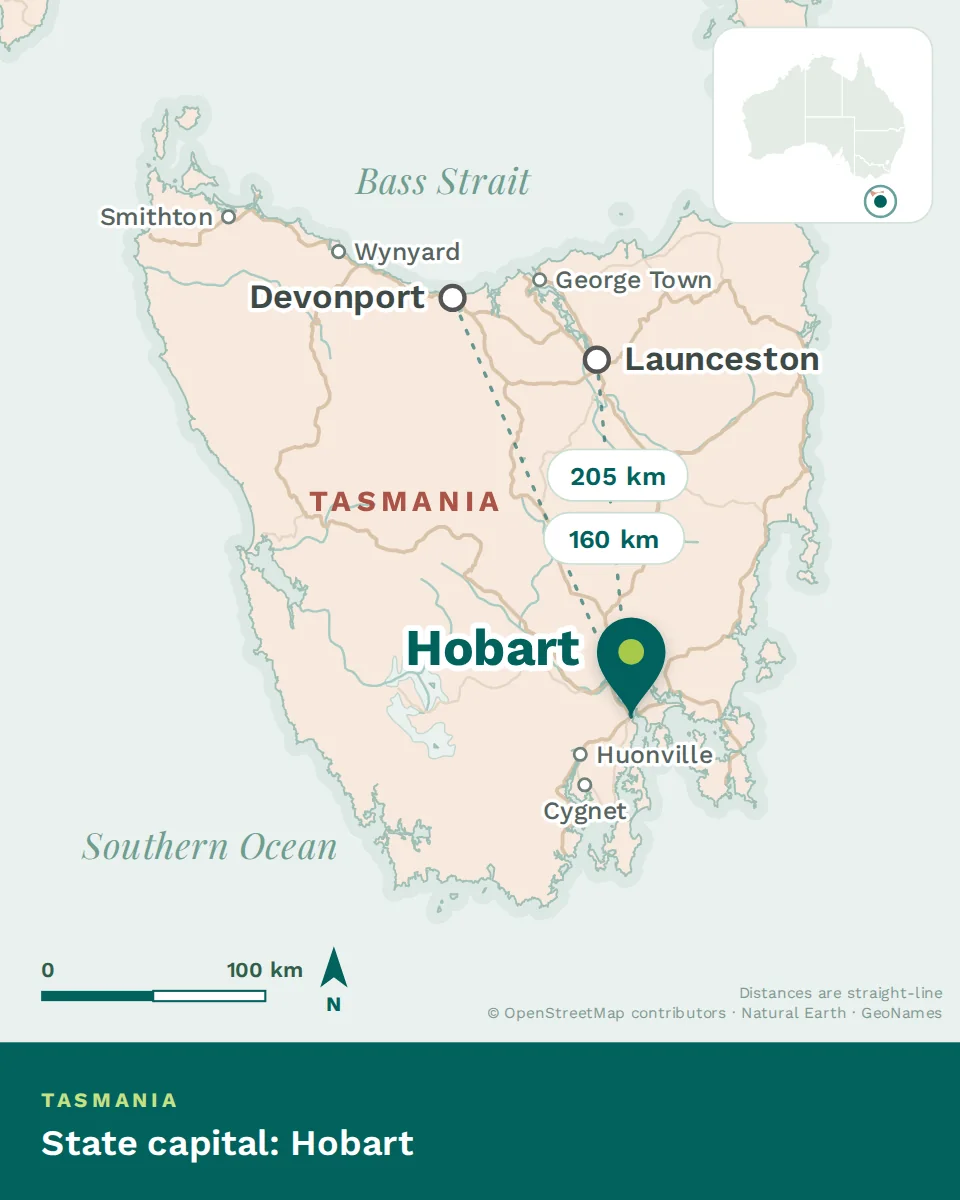
The south
Hobart and its surrounds hold nearly half the state: the harbour city itself, the beach suburbs of Kingston and Blackmans Bay, and the Huon Valley’s orchards and forests half an hour out. This is where the principal referral hospital, the widest job market and most of the island’s cultural life sit — MONA, Salamanca, the festival calendar. If you take a southern post, the mountain and the Tasman Peninsula’s sea cliffs are your local geography.
The north
Launceston is the elegant second city — heritage streets, the Cataract Gorge running wild through the middle of town, and the kanamaluka / Tamar Valley’s vineyards all around. It carries the north’s major teaching hospital, noticeably gentler housing costs, and a quietly strong food-and-wine scene. The east coast — Freycinet, the Bay of Fires — is its weekend playground.
The north-west and west
Devonport, where the Spirit of Tasmania docks, and Burnie, the working port with the coast’s referral hospital, anchor a string of friendly towns along Bass Strait. Behind them the island turns wild: Cradle Mountain ninety minutes inland, and beyond it takayna / the Tarkine, one of the largest temperate rainforests on earth. Health care out here runs on breadth, community and weather-watching.
A year in the weather
Cool temperate, with four real seasons — closer to England or the South Island of New Zealand than to mainland Australia. Summers are mild and long-lit, with evenings that stay cool; winters are cold, crisp and often blue-skied, with snow settling on kunanyi and the highlands. The weather changes fast in any month: layers and a good jacket are year-round equipment, and the UV is fierce despite the cool air.
Two practical notes, both about winter. Ask how any home is heated before you sign — a heat pump and decent curtains change the season entirely. And if you’ll drive the mountain or highland roads, learn the black-ice habits early; locals will teach you cheerfully.
Getting on and off the island
Two clocks matter here: Tasmania runs on the same time as Melbourne and Sydney (AEST, daylight saving included), and Melbourne itself is about 75 minutes’ flight from either Hobart or Launceston, with direct flights on to Sydney, Brisbane and beyond. The Spirit of Tasmania sails overnight between Devonport and Geelong — the practical way to bring a car and your belongings across Bass Strait, and many families’ preferred way to arrive.
On the island itself, the road network does the work: Hobart to Launceston is two and a half hours, the east coast about two from either city, and Cradle Mountain ninety minutes from the north-west towns. Getting around has the detail.