
Before the practical chapters, orientation. South Australia is the driest state on the driest inhabited continent, and it divides — for a newcomer’s purposes — into three quite different places sharing one capital, one climate pattern and one eccentric clock.
The three South Australias
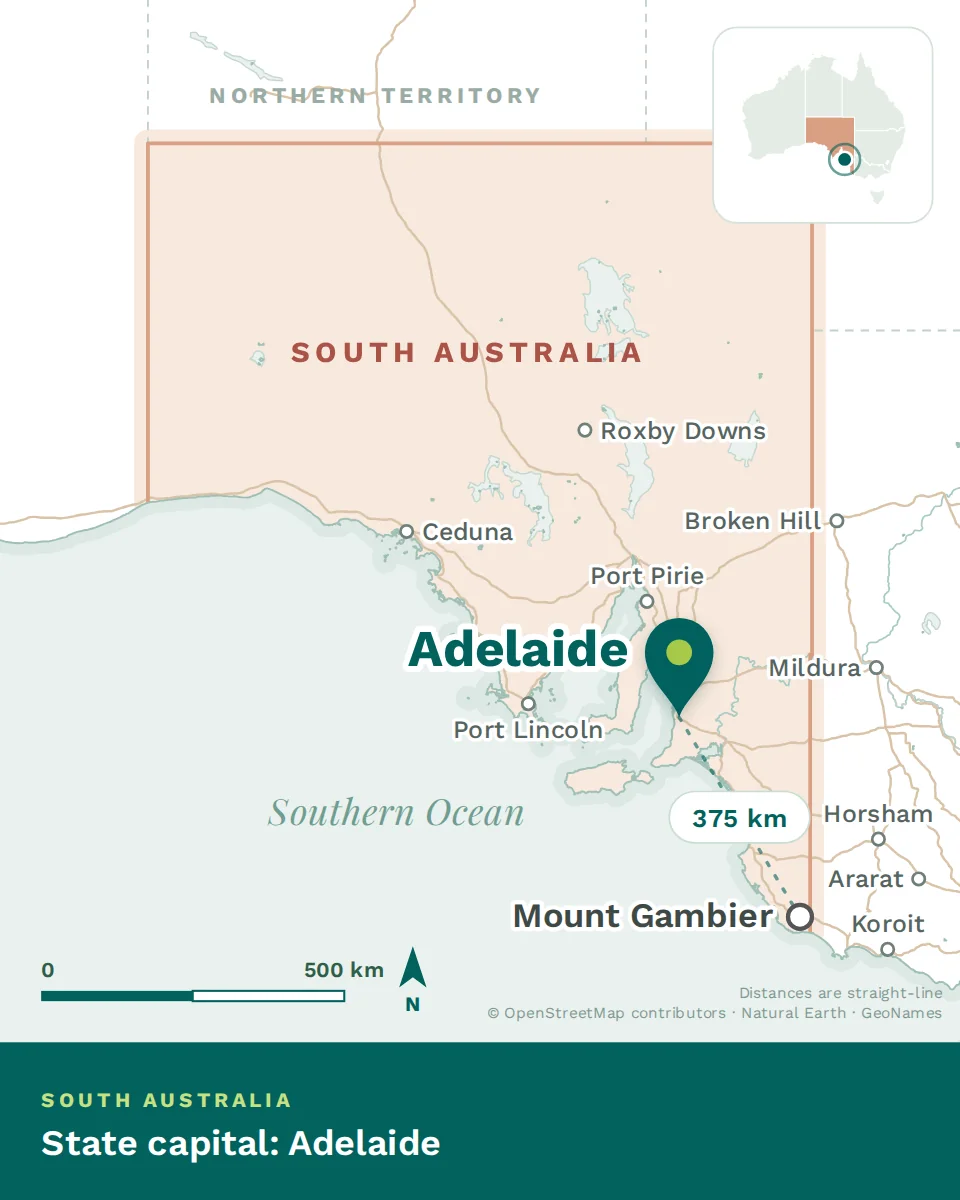
Adelaide and its ring
The capital, the Hills behind it, the Barossa and Clare to the north, McLaren Vale and the Fleurieu Peninsula to the south. Nine in ten of the state’s health jobs sit inside this circle, and nearly everything in it is within an hour of everything else. If you take a city post, this ring is your whole life map — beaches, vines, hills and wards.
The green South-East
The Limestone Coast runs to the Victorian border — the coolest, wettest, greenest corner of the state, built on pine forests, vineyards and dairy country around the state’s largest regional city with its famous volcanic Blue Lake. It looks and feels closer to rural Victoria than to the outback, and its referral hospital serves a wide catchment.
The gulfs and the outback
North and west of Adelaide the country opens out: the Yorke Peninsula’s quiet farming coast, the industrial towns of the Upper Spencer Gulf betting big on steel and hydrogen, the Eyre Peninsula’s seafood ports facing the Southern Ocean, and beyond them the Flinders Ranges and the arid far north, where health care runs on small teams, aviation and telehealth.
A year in the weather
The climate is Mediterranean: hot, dry summers and mild, green winters, with the rain arriving May to September. Summer brings real heatwaves — runs of days past 40° most years — which end, theatrically, with a cool change rolling in off the Southern Ocean. The Hills sit several degrees cooler and greener; the South-East is the mildest corner; the far north is properly arid.
Two practical notes. Older housing stock often has thin insulation and patchy heating — make a good split system a rental-search criterion, for both ends of the year. And take the heat itself seriously: hydration, sun protection and a plan for very hot days matter, especially with children or older family members.
The half-hour clock
South Australia runs on Australian Central Standard Time — UTC+9½, thirty minutes behind Sydney and Melbourne — and, unlike Queensland, it does observe daylight saving, becoming UTC+10½ each summer. The practical effects are small but constant: national meetings land at five past the half-hour, broadcast times shift, and Perth sits ninety minutes behind you in winter. You adjust within a month; your phone adjusts instantly.
Getting in and out
Adelaide Airport is unusually close to the city — about fifteen minutes from the CBD, on the way to the beach. It flies direct to every Australian capital and to a handful of international hubs, so most of the world is one stop away; and regional services reach Port Lincoln, Whyalla, Mount Gambier and Kangaroo Island. Melbourne is a day’s drive down the coast or up the highway; everywhere else east is a flight.