
Nelson sits in a rain shadow at the head of a sheltered bay, with mountains taking the weather before it arrives. That single fact explains the sunshine, the orchards, the vineyards and why so many people want to live here.
The shape of the region
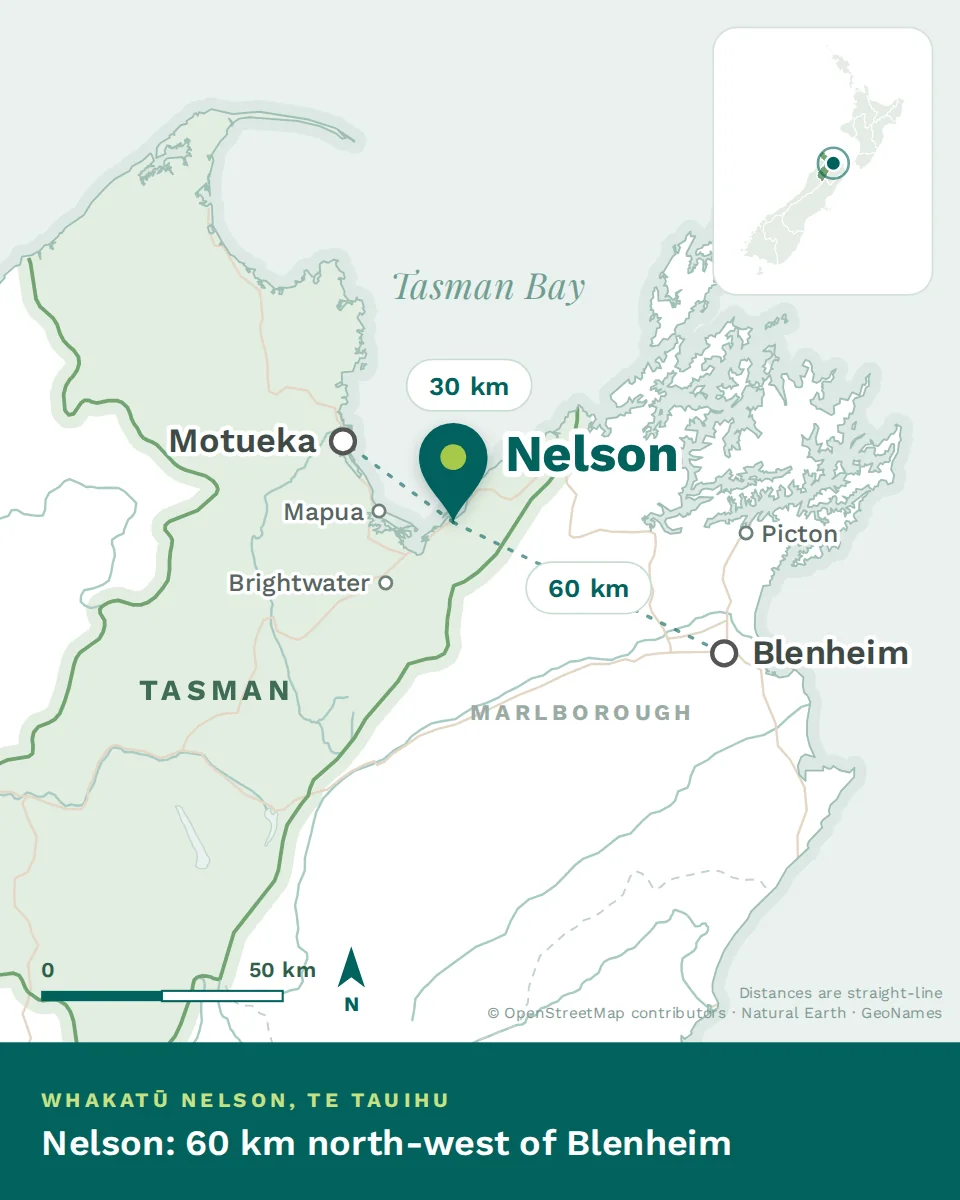
Nelson city curls around the eastern end of Tasman Bay, hemmed in by hills, with Tahunanui beach and the Boulder Bank on its seaward side. Twenty minutes south-west, Richmond sits on the flat Waimea plain — the region’s growth area and, for many, its practical centre.
From Richmond the Tasman District runs west: Māpua on its inlet, Motueka among the orchards, and Kaiteriteri’s golden sand at the edge of Abel Tasman National Park. Beyond that the Tākaka Hill climbs over into Golden Bay — Mohua — a separate world with its own famously independent community.
Inland and south, the land rises into Kahurangi and Nelson Lakes national parks: beech forest, alpine lakes, and the start of the Heaphy Track. South-east, the road to Blenheim and the Marlborough Sounds crosses the Whangamoa and Rai hills.
The four seasons
Indicative daytime highs on the coast. Inland on the Waimea plain and towards Nelson Lakes, winter frosts are routine and summer days are hotter.
What the numbers don’t tell you
The sunshine is the best in New Zealand. Around 2,400 hours a year — Nelson takes the national title most years. The ranges to the west and south strip the prevailing weather of its rain before it reaches the bay, which is why this corner is so consistently bright.
Dry summers mean water restrictions. The Waimea plain is intensively horticultural and the region has had real water-supply pressure in dry years. Restrictions in summer are normal, and worth knowing if you are planning a garden.
Winters are mild on the coast and cold inland. Nelson itself rarely does anything severe. Twenty minutes inland on the plain, frost is a regular winter feature, and the alpine parks get proper snow.
The housing stock needs checking, as everywhere. Older Nelson villas are charming and frequently under-insulated. Ask about insulation, ventilation and a heat pump, and check the Healthy Homes compliance statement, which is a legal requirement and covered in the national Renting in New Zealand chapter.
The Tākaka Hill is a real piece of road. The only route to Golden Bay, and a steep winding climb over marble country. It closes occasionally in bad weather, which isolates the communities beyond it.
Where things are, in driving time
Words you’ll hear
A sheltered, sunlit bay with three national parks and the best sunshine hours in the country. Mild on the coast, frosty inland, dry in summer. The climate is why everyone wants to be here — which is also why the housing costs what it does. Where clinicians live is next.