
Before the practical chapters, orientation. Brisbane is not a grid and not a strip — it is a river city built across ridges, which is why two suburbs four kilometres apart can feel like different towns, and why the map repays ten minutes of study before you choose a rental.
How the city is laid out
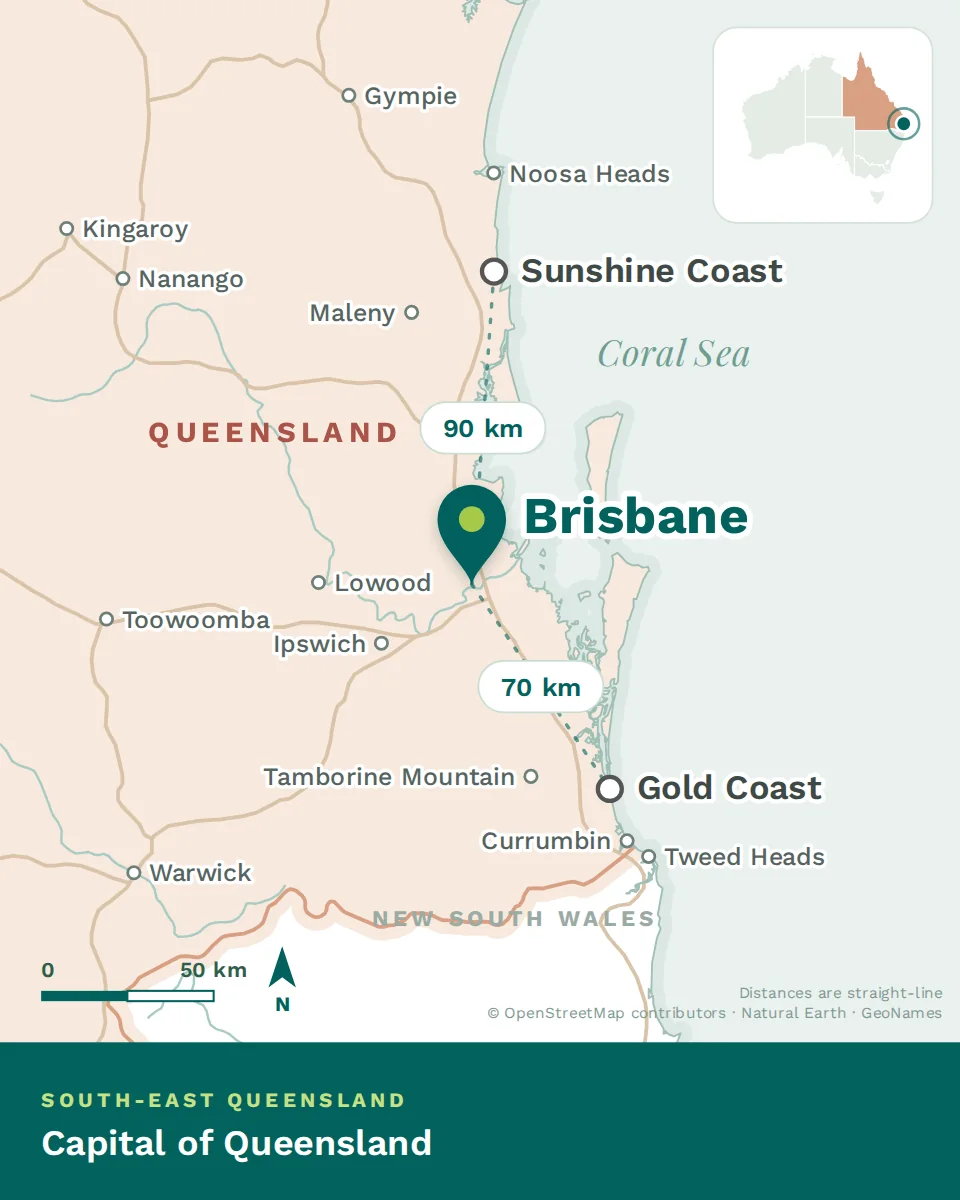
The river and the centre
The CBD sits in a tight bend, with South Bank facing it across the water — gallery, museum, a swimming lagoon, and the Goodwill Bridge carrying walkers and cyclists between the two. This is where the tertiary hospital work concentrates, and where the ferry network is densest. Kangaroo Point’s cliffs, Story Bridge and the New Farm reach are all within a few minutes of it.
The inner ring
Four to six kilometres out in every direction: Paddington and Bardon up the western ridges, New Farm and Teneriffe on the river, West End in its own bend, Bulimba and Hawthorne east, Wilston and Windsor north. Timber Queenslanders, corner cafés, and a walkable life. This is where most clinicians start and many stay.
The corridors and the bay
Beyond that the city runs a long way: the growth corridors north toward the Sunshine Coast and south toward the Gold Coast, the bayside suburbs east at Wynnum and Manly with Moreton Bay in front of them, Ipswich and the valley west. The metro area is roughly a hundred kilometres across, so the corridor you pick matters as much as the suburb.
A subtropical year
Two seasons matter here, and the shoulder months are a gift. Summer, December to March, is hot and humid with a pronounced afternoon storm season and most of the year’s rain. Winter, June to August, is the reason people move: dry, still, blue, around 21 degrees, and cool enough at night for a jumper. Spring and autumn are simply pleasant, and jacaranda season in late spring turns whole streets purple.
Two practical notes. Air conditioning is not a luxury in a Brisbane summer — make it a rental criterion, and ask about ceiling fans and cross-breezes too, because a well-designed Queenslander does half the work. And take the storm season seriously: hail, flash flooding and power cuts are normal, and the city has a long memory of river flooding, so check a property’s flood history before you sign anything.
The clock
Queensland runs on UTC+10 and does not observe daylight saving. In summer that means light from about 4.45am and dark by seven, so mornings are when the city lives: gyms, swims, dog walks and coffee all start early, and evening plans start earlier than southerners expect. It also means Brisbane sits an hour behind Sydney and Melbourne for four months of the year — worth remembering for interstate meetings and family calls.
Getting in and out
Brisbane Airport is the country’s third international gateway, about twenty minutes from the city on the Airtrain, with direct flights across Asia and the Pacific and to every Australian capital. By road, the Gold Coast is an hour south, the Sunshine Coast an hour north, and the northern rivers of New South Wales a comfortable weekend. Sydney is a 90-minute flight; Melbourne just over two hours.