
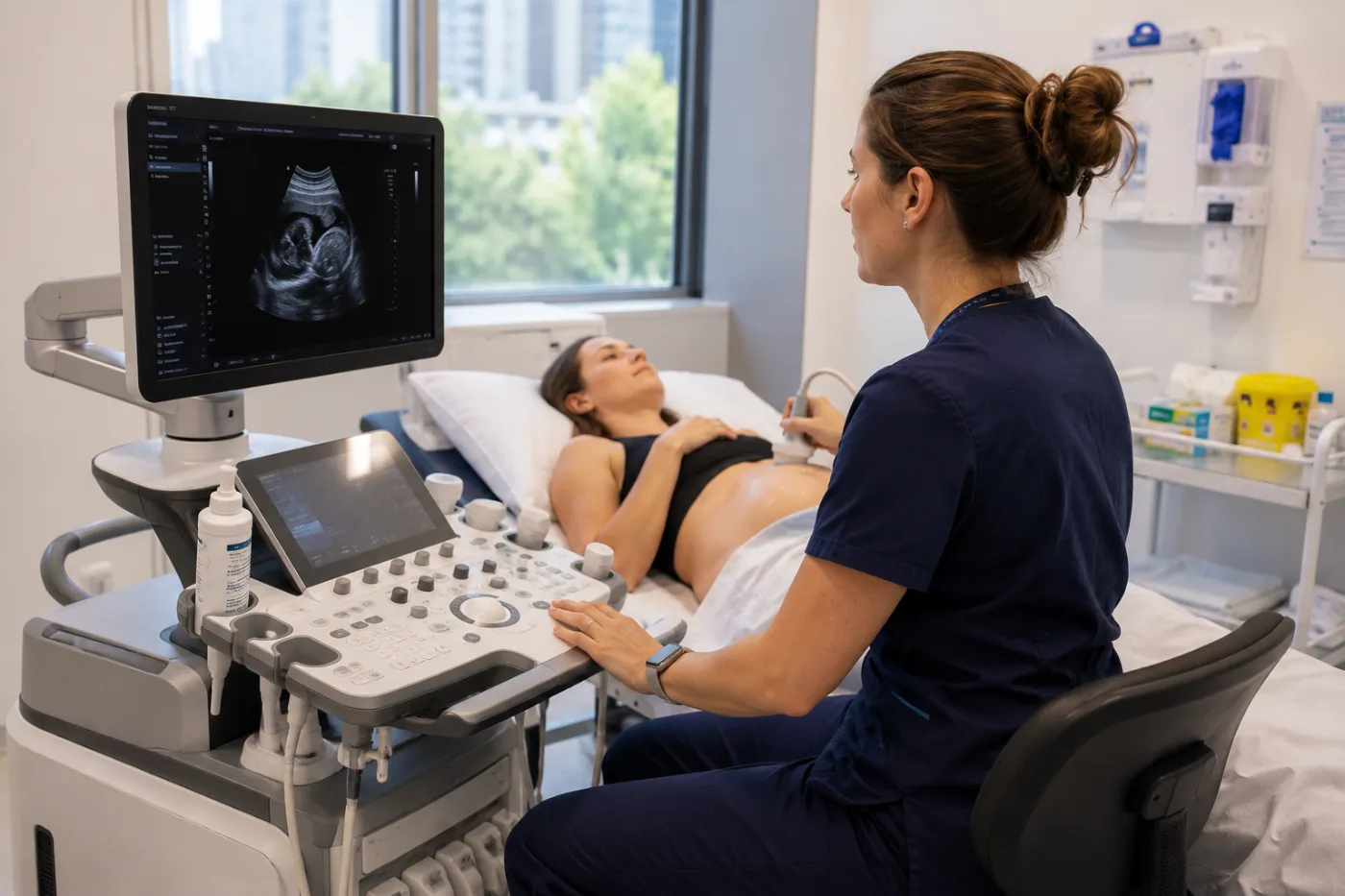
Sonography, with autonomy and adventure.
Your skills are highly sought after.
Needed across New Zealand, from major centres to regional communities.
Few professions are wanted here more than yours.
Sonographers are among the most sought-after health professionals in New Zealand. The shortage is sustained, and it runs across general, obstetric, vascular, musculoskeletal and cardiac ultrasound, from rural services to tertiary centres.
- Very high demand, nationwide
- Autonomous scanning and a broad clinical scope
- Tier 1 Green List — straight to residence
The work is autonomous and the pay is among the strongest in allied health. The scanning is excellent, and so are the weekends — this is a country built for living as well as working.
Where you could live →
The scope is protected, and the independence is real.
Sonography is a protected MRTB scope. Most sonographers work autonomously across a broad case mix — abdominal, obstetric and gynaecological, musculoskeletal, vascular and small parts — and many focus on a sub-speciality while keeping their general scanning.
Cardiac sonography (echocardiography) is its own scope rather than a rotation: transthoracic, transoesophageal and stress echo, with a recognised echo qualification such as a DMU or PGDip/MSc Echo behind it. Reporting and advanced practice sit on their own higher salary scale, so the ladder is a real one.
How pay is set →
Only one of the two countries regulates the title.
Sonography is where the two diverge most sharply. New Zealand registers sonographers as a health profession with a protected scope. Australia does not regulate the title; professional recognition and an accreditation register govern who can scan and whose scans attract funding.
That one difference shapes the paperwork before you arrive, who can employ you, and how much say you have over your own practice once you are there. Registration is a separate process in each country, so never assume one follows from the other. Where your salary goes further is a separate question again.
Australia or New Zealand? →
The essentials, in five minutes
Seven questions people ask before they decide. Open the ones that matter to you.
Can I work there?Yes, with MRTB sonography registration
You register with the Medical Radiation Technologists Board under the sonography scope and hold an Annual Practising Certificate. Sonography is a protected scope, so every application is assessed individually against the New Zealand standard for the scope you apply under. Note that sonography sits outside trans-Tasman recognition — Australian-qualified sonographers apply as overseas-trained. The Board decides, not us.
Check my pathway →What could I earn?Around NZ$120,000–$162,000
Indicative public range on the 11-step APEX scale, read from the signed agreement; reporting sonographers sit on their own higher scale, indicatively circa NZ$131,000–$173,000. Some services sit on a PSA agreement instead. Private imaging is outside the collective agreements, so there is no scale to check against — we ask the employer and get it in writing.
How pay is set →Where are the jobs?One of the deepest shortages
Sonography is on the Tier 1 Green List, with a Straight to Residence pathway, and it is actively recruited nationwide — public radiology and cardiology departments and private imaging networks, in the main centres and the provinces alike.
See current roles →What will the work be like?Autonomous scanning
Broad diagnostic ultrasound with real independence at the machine — abdominal, obstetric and gynaecological, musculoskeletal, vascular and small parts — with room to go deep on a sub-speciality. Cardiac sonography is its own MRTB scope rather than a rotation.
The work itself →Can I bring my family?Yes, and residence is quicker here
Sonographers sit in Tier 1 of the Green List — Straight to Residence — and that route brings partner work rights and schooling for children with it. Schools, childcare and the family logistics are explained once, properly, in the family guide. Checked against Immigration New Zealand’s Green List (Appendix 13, in force from 9 March 2026); the list changes, so confirm it against your own occupation before you plan around it.
Family moves, explained →What will moving cost?Budget for real fees
Board registration NZ$922 plus NZ$510 for the first practising certificate, qualification verification, visa fees for everyone moving, flights and shipping. Some employers contribute to relocation, some don’t — we get whatever is offered in writing.
The move, costed →How long could this take?Usually several months
Registration and the visa run largely in parallel, and because each sonography application is assessed individually, document verification and evidence of recent scanning practice are usually the slow part. Start collecting that evidence early.
The journey, sequenced →Current opportunities
Roles we're recruiting for right now. If none is quite right, register your interest and we'll be in touch when something fits.
The detail, when you want it
Registration and pay, in full. Everything is here, one section at a time.
Getting registeredRegistration overview
Reviewed July 2026 · checked against the Medical Radiation Technologists Board’s current published guidance
To practise as a sonographer in Aotearoa you'll register with the Medical Radiation Technologists Board (MRTB) under the sonography scope and hold a current Annual Practising Certificate (APC). Sonography is a protected scope — every application is assessed individually.
Your qualifications and experience are assessed for equivalence to the New Zealand standard for the scope you apply under — general sonography, or a sub-speciality scope such as cardiac sonography (echocardiography). You'll typically need:
- Verification of your sonography qualification
- Evidence of recent clinical practice
- Certificates of good standing & criminal-history checks
- Confirmation of English-language proficiency, if required
Pathways into registration
Your route depends on where you trained and how closely your experience aligns with the New Zealand sonography standard.
Internationally Qualified pathway
For sonographers trained outside New Zealand and Australia (including the UK). Your qualification and experience are assessed for equivalence to the relevant sonography scope.
Trans-Tasman & scope-specific
Australian-qualified sonographers apply as overseas-trained; cardiac and other sub-speciality applicants are assessed against the specific scope they intend to practise in.
Your registration resources, all on one page
Read the Board's own registration guide, work through the checklist, then go straight to the people who register you.
Prefer a download? Registration guide · Checklist
Registration checklist
What to gather before you apply to the MRTB:
- Certified copies of your qualifications
- Evidence of recent, relevant clinical practice
- A certificate of good standing from every authority you’ve registered with
- A police / criminal-history check
- Proof of identity, plus any name-change documents
- English-language evidence (IELTS or OET), if required
- One personal and one professional referee
- Your application fee, ready at submission
Advice & notes
Start early
Gathering documents before you apply is the single best way to avoid delays. Missing paperwork is the most common hold-up.
Mind the dates
Certificates of good standing and certified copies have a short validity window. Time them so they are still current when you submit — and note the Board’s window and Immigration New Zealand’s are not the same.
Then your visa
Your visa follows the job offer, not the other way round. We’ll guide the order so nothing happens out of sequence.
You’re not on your own
We’ll review your documents with you before you submit, and stay alongside you through every step.
Salary & benefitsAmong the strongest pay in allied health
Sonography is one of the best-paid roles in allied health here, and reporting work pays better again. Figures are indicative — we’ll confirm your actual number for a specific role before you decide anything.
Indicative, on the APEX public scale. Reporting sonographers sit on their own higher scale, indicatively NZ$131,000–$173,000.
Alternative scale
Indicatively NZ$102,000–$138,000 on an 11-step scale, depending on the employing service.
On top of base
Overtime and penal rates, higher-duties and night-shift allowances, plus on-call provisions.
Varies by employer
Some employers contribute towards the move, others don’t. We ask on your behalf and get whatever is on offer confirmed in writing before you decide.
Tier 1 Green List
Straight to Residence pathway, with partner work rights and schooling for children.
4–5 weeks + APC
Four weeks' leave (five after five years), sick leave, public holidays; APC usually reimbursed once you start.
These are public-system figures. Private imaging sits outside the collective agreements and sets its own rates, so there is no scale to check a private figure against — we ask the employer directly and get it in writing. Public pay is confirmed against the relevant APEX or PSA agreement for each role; figures are indicative, rounded down to the nearest thousand, and change year to year. View the APEX collective agreements →

Sonographers are some of the most fought-over health professionals on both sides of the Tasman — so the question isn't whether you'll be wanted, but what kind of working life you want.
What surprises people is how strong New Zealand's public pay is for this profession — among the best in allied health, with reporting roles higher still. Add Tier 1 straight-to-residence and a broad, autonomous case mix, and it's one of the best moves a sonographer can make.
Tell me the life you want — a cardiac sub-speciality, a regional lifestyle role, more time at the weekend — and I can usually find a sonography role to fit it, rather than the other way round.
SophieFounder, Ethicare Resourcing
What we can’t promise
Three things we won’t guarantee, and what we do instead.
Timelines that aren’t ours to give
Registration sits with the Medical Radiation Technologists Board and visas with Immigration New Zealand. We’ll give you the likely range, keep your file complete and moving, and chase what can be chased — but we won’t quote a faster number just to win you over.
A specific job in a specific suburb
Vacancies move. If your heart is set on one workplace in one corner of one city, we’ll tell you plainly how long that wait could be — before you resign anything, not after.
That the move is right for you
Some moves shouldn’t happen. If the scope, the pay maths or the family logistics don’t stack up, we’ll say so plainly.
Frequently asked
Will I be asked to sit an exam?
Sometimes — sonography is the scope where it's most likely. There's no exam if the MRTB assesses your qualification as equivalent; if not, you're offered the Board's online examination as your pathway. We'll help you gauge the likelihood from your specific qualification.
Which scope do I register under?
The one that matches your training — general sonography, or cardiac sonography (echo), which needs a recognised echo qualification. We'll help you target the right one.
Will I be supervised when I start?
Possibly — overseas-qualified sonographers may begin under provisional registration with a period of supervised practice. In such a short-staffed profession it's usually easy to arrange.
How does it compare to Australia?
Unusually for allied health, New Zealand's public sonographer pay is competitive, so the 'Australia pays more' rule doesn't really apply. Australia offers bigger private volumes; New Zealand offers autonomy, Tier 1 residence and real choice of location.
Where would you like to be scanning next year?
Relocating to a new country can feel overwhelming at times, and you won't be doing it on your own. Find your registration pathway in two minutes, then send us your CV and we’ll take it from there.