
Queensland runs from subtropical river city to monsoonal tropics to red-dirt outback — a state so long that its two ends have different seasons. Understanding the three Queenslands is the fastest way to understand which one is yours.
The three Queenslands
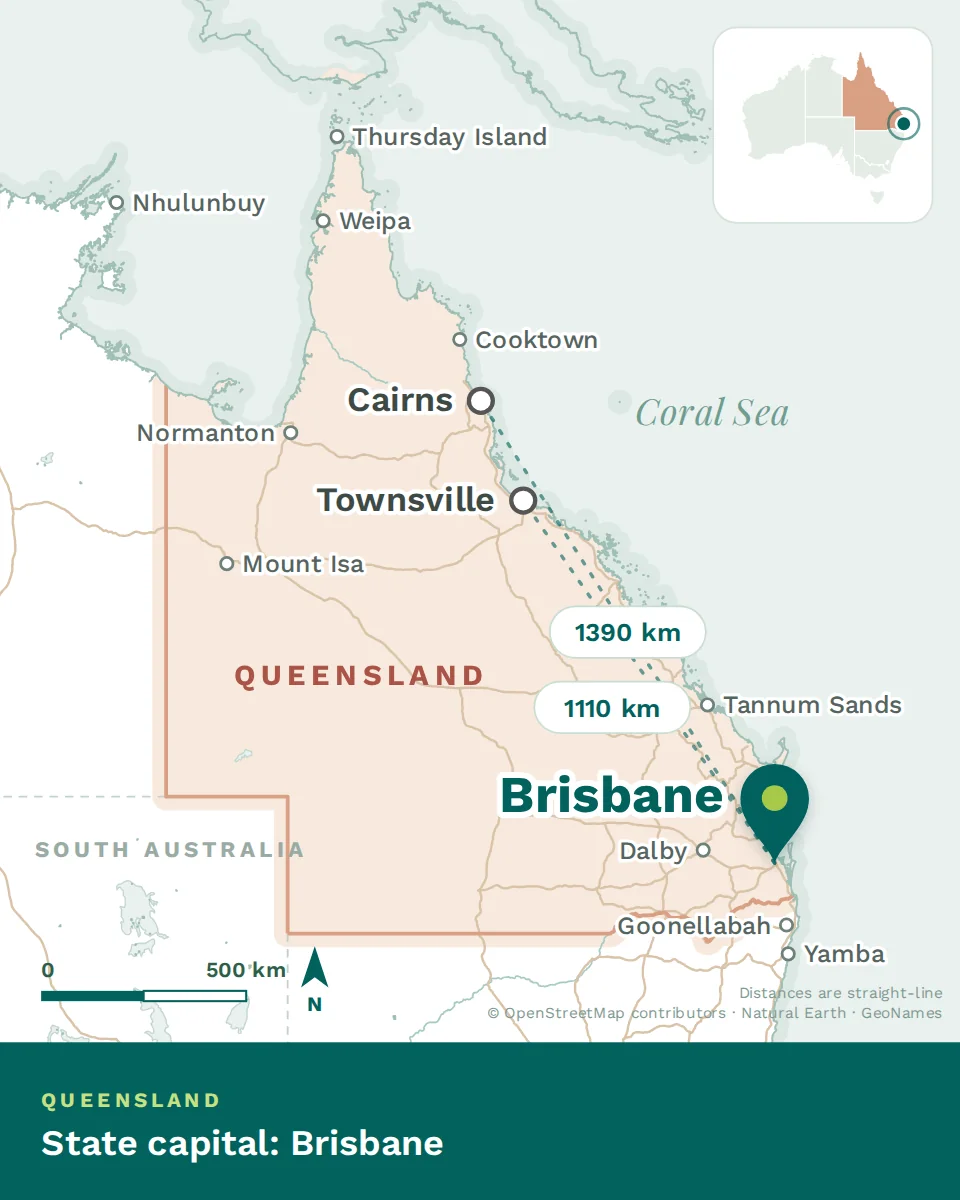
The south-east corner is where two-thirds of the state lives: Brisbane on its river, the Gold Coast’s forty-kilometre beach strip south to the border, the Sunshine Coast’s surf towns north, and the Scenic Rim’s green hinterland behind. Subtropical — hot wet summers, warm dry winters, storm season as the soundtrack.
The coast runs north for two thousand kilometres: Bundaberg and the southern reef gateways, Rockhampton and Mackay serving cattle and coal country, then the true tropics — Townsville, dry and garrison-tough; Cairns, wet and rainforest-green, where the reef meets the Daintree. Monsoon wet seasons, glorious dry winters, cyclone watch from November.
The inland climbs the range to Toowoomba’s gardens, then runs west through farm and cattle country into the outback proper — Longreach, Mount Isa’s mining city, and distances where medicine is flown, not driven.
The seasons, south-east corner
Indicative Brisbane daytime highs. Cairns and Townsville run hotter with a true wet season (roughly December–April); the inland west adds real heat in summer and cold clear nights in winter.
What the numbers don’t tell you
Winter is the season the state is famous for. Dry, cloudless, twenty-two degrees — from June to August the south-east has arguably the best city weather on earth, and the north has its "dry", which is the tourist season for a reason.
The storm season is pure theatre. South-east summer afternoons build purple thunderheads that break at four with hail warnings and drenching rain, then clear by dinner. Download the radar app early; locals treat it as a spectator sport with rules.
The wet season is a different contract. North of about Mackay, December to April means monsoonal rain, road cuts, and the cyclone watch. It is well-managed and locals plan around it — but it is real, and the induction your service gives you is not a formality.
No daylight saving changes the shape of days. Summer light starts before five and ends by seven. The state runs early: 6am gyms full, 7am meetings normal, evening barbecues in winter rather than summer.
Sun protection is clinical-grade serious here. Queensland has the world’s highest melanoma rates. Hats, rash shirts and 50+ are school policy and should be yours — the master’s Living in Australia covers the everyday rules.
Where things are, in travel time
Words you’ll hear
Three Queenslands: the subtropical corner, the tropical coast, the outback west. Winter is the universal payoff; summer asks more the further north you go. Which Queensland you choose decides everything else — Where clinicians live is next.