
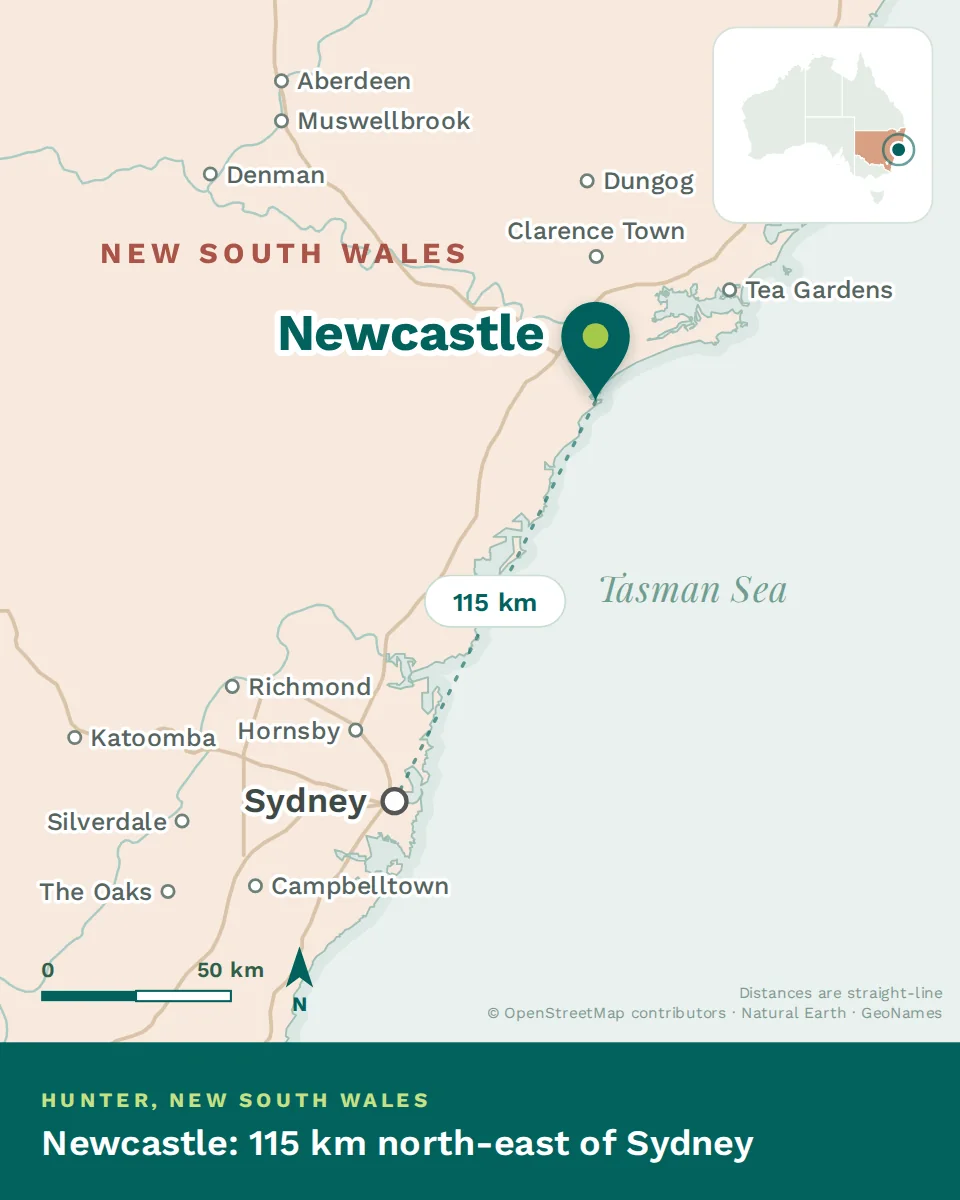
Newcastle sits at the mouth of the Hunter River, built on coal and steel and rebuilt, more than once, into something else. Here’s the geography, the history and the people, in brief.
A temperate coast, four real seasons
Summer
Dec – Feb
18–27°
Warm, occasional storms
Autumn
Mar – May
14–23°
Mild, settled
Winter
Jun – Aug
7–17°
Cool, clear, and mild by Australian standards
Spring
Sep – Nov
12–22°
Warming, building toward summer
Distinct seasons, unlike the subtropical coast further north — a mild winter, a warm summer, and the occasional east-coast low that can bring heavy rain and, in parts of the wider Hunter, flooding.
A short history
Before European settlement
Awabakal & Worimi Country
The Awabakal people are the traditional custodians of the Newcastle area, with the Worimi people recognised further north.
1804
A coal and penal settlement
Newcastle is founded at the mouth of the Hunter River, initially to mine coal using convict labour.
1915 – 1999
The steel city
BHP’s steelworks anchors the local economy for most of the 20th century, shaping the city’s identity and its skyline.
1989
The Newcastle earthquake
A significant earthquake causes widespread damage and loss of life, and the rebuilding that followed reshaped parts of the inner city.
Today
A university and health city
Newcastle’s economy has rebuilt around health, education and the port, with the university and the main hospital campus as anchors.
Who lives here
A growing sea-change destination
A steady flow of Sydneysiders relocate here for the lifestyle and the housing, changing several suburbs quickly.
A university city
The University of Newcastle, including its well-regarded medical school, brings a real student and academic population.
A working port, still
Newcastle remains one of the world’s largest coal export ports, a visible part of the harbour’s daily life.
A mixed economy
Health, education, the port and a growing tech and creative sector have replaced steel as the city’s backbone.