
Dunedin sits at the head of a long, narrow harbour on the south-east coast of the South Island, with hills on three sides and the open Pacific on the fourth. Understanding that shape explains almost everything about how the city works.
The four parts of the city
The climate
Dunedin has a cool temperate maritime climate. The sea moderates it in both directions: summers are mild, not hot, and winters are cool without freezing. The mean annual temperature is around 11°C, and hard frosts are less common than people expect from the latitude.
What defines the year is not cold, it is variability and cloud. A February day can be 25°C and still. A February week can be 15°C and grey. Locals dress in layers and stop discussing it.
Getting your bearings
The shape of the place
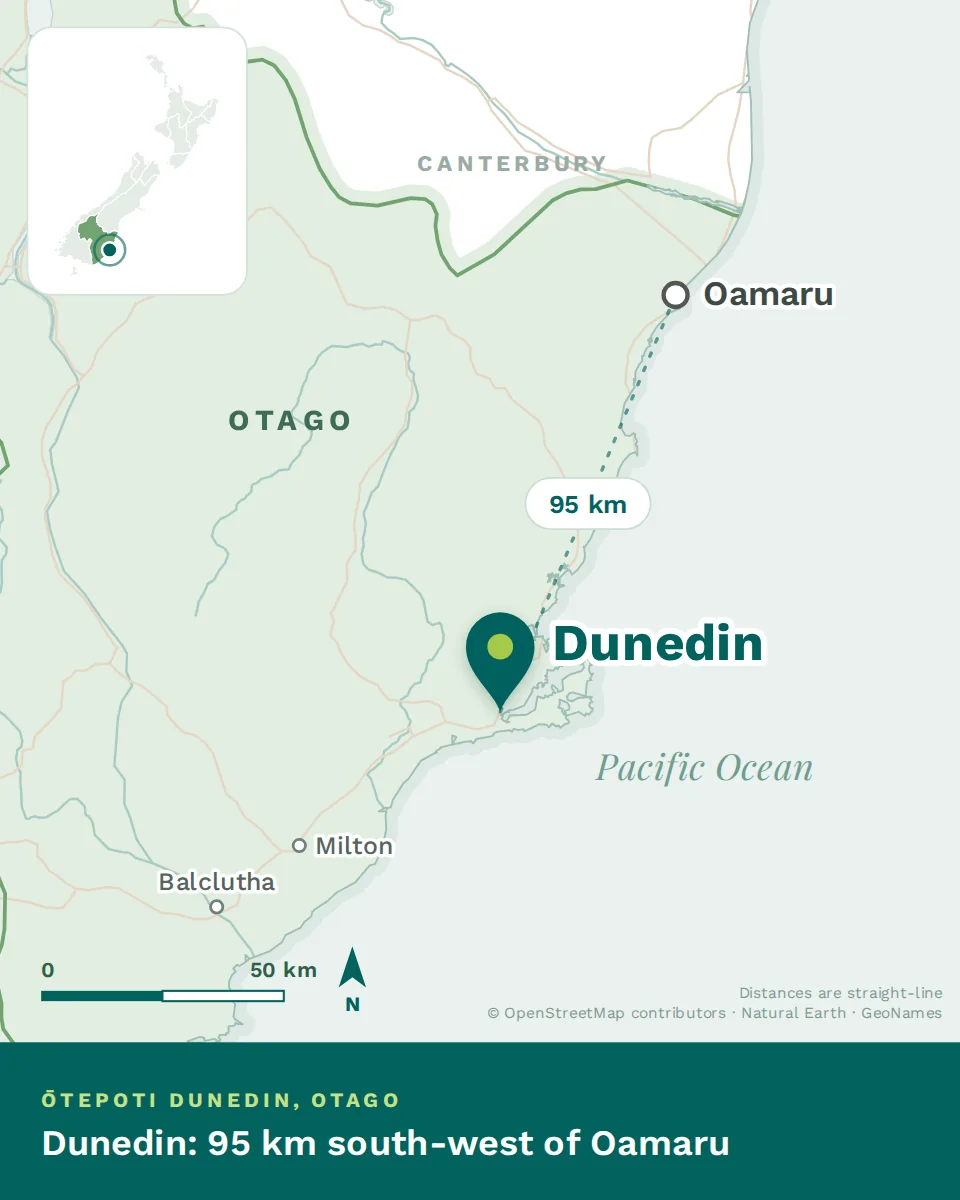
Dunedin sits at the head of a long harbour, with the city built up the slopes of an ancient volcanic basin. The flat central grid — the Octagon, the university, the hospital, the warehouse district — occupies the harbour floor, and everything else climbs.
Out along the harbour’s northern shore the road runs to Port Chalmers, the working port. On the southern side, the Otago Peninsula stretches twenty kilometres to Taiaroa Head, with albatross, penguins and sea lions at the end of it. Behind the city to the west, the hill suburbs give way quickly to farmland and then to Central Otago.
The scale is the thing that surprises people. Dunedin has the architecture and civic infrastructure of a much larger city — the legacy of the gold rush, when it was briefly the wealthiest place in New Zealand — on a population of around 130,000. That mismatch is why the city feels grander than its size, and why housing is such good value.
- On the cold. Dunedin is cooler than most of New Zealand but rarely extreme. The problem is old housing and wind chill rather than the temperature itself.
- On the hills. The city is built into an amphitheatre around the harbour. Which contour line you live on changes your sun, your view and your walk home.
- On the light. Being this far south means long summer evenings and short winter days. It affects people differently — take it seriously if you know it affects you.
Dunedin is a small city in a big landscape. Nothing in it is more than twenty minutes from anything else, and the edge of it is wilder than the edge of any other New Zealand city.