
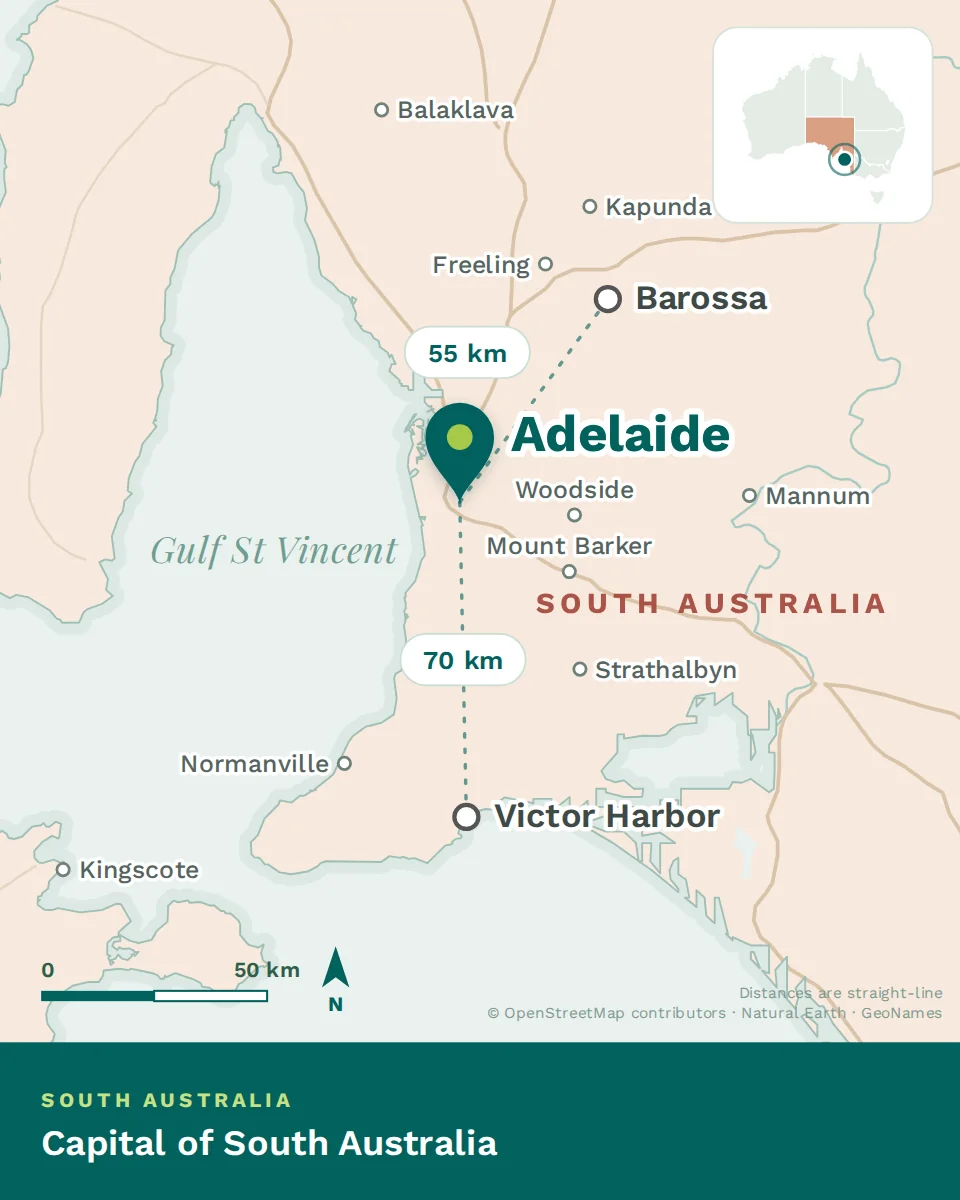
Before the practical chapters, orientation. Adelaide is the easiest Australian capital to read: a planned grid in the middle, parklands all the way around it, the hills on one side and the gulf on the other, and almost nothing more than half an hour away.
How the city is laid out
The grid and the parklands
The city centre is a mile-square grid of wide streets and five public squares, wrapped completely by parkland — there is no continuous built edge between the city and North Adelaide. The Torrens runs through that green belt, with the cultural boulevard of North Terrace along the northern edge carrying the museum, the gallery, the university and the newest hospital-and-research precinct.
The coast
Thirty-odd kilometres of white sand run down the western edge, from North Haven through Henley, Glenelg and Brighton to Seacliff and, further south, Sellicks. Glenelg has the tram; the rest have jetties, esplanades and gulf sunsets. The beach suburbs are twenty to thirty minutes from the city and priced accordingly.
The hills and the valleys
Behind the city the Adelaide Hills rise within twenty minutes — cooler, greener, with autumn colour and Sunday-morning fog. Beyond them the wine valleys wrap the capital: the Barossa and Clare to the north, McLaren Vale and the Fleurieu to the south, all inside an hour.
A Mediterranean year
Hot, dry summers and mild, green winters, with the rain arriving May to September. Summer brings real heatwaves — runs of days past 40° most years — which end, theatrically, with a cool change rolling in off the Southern Ocean that can drop the temperature ten degrees in minutes. The Hills sit several degrees cooler; the coast gets the sea breeze first.
Two practical notes. Older housing stock often has thin insulation and patchy heating — make a good split system a rental-search criterion, for both ends of the year. And take the heat itself seriously: hydration, sun protection and a plan for very hot days matter, especially with children or older family members.
The half-hour clock
South Australia runs on Australian Central Standard Time — UTC+9½, thirty minutes behind Sydney and Melbourne — and, unlike Queensland, it does observe daylight saving. The practical effects are small but constant: national meetings land at five past the half-hour, broadcast times shift, and Perth sits ninety minutes behind you in winter. You adjust within a month; your phone adjusts instantly.
Getting in and out
Adelaide Airport is unusually close to the city — about fifteen minutes from the CBD, on the way to the beach. It flies direct to every Australian capital and to a handful of international hubs, so most of the world is one stop away. Melbourne is a day’s drive or a short flight; everywhere else east is a flight. The South Australia guide covers the drives out to the regions.