
Take your sonography career somewhere bigger.
Sonographers don’t register through Ahpra.
The Australian pathway works differently from many imaging professions.
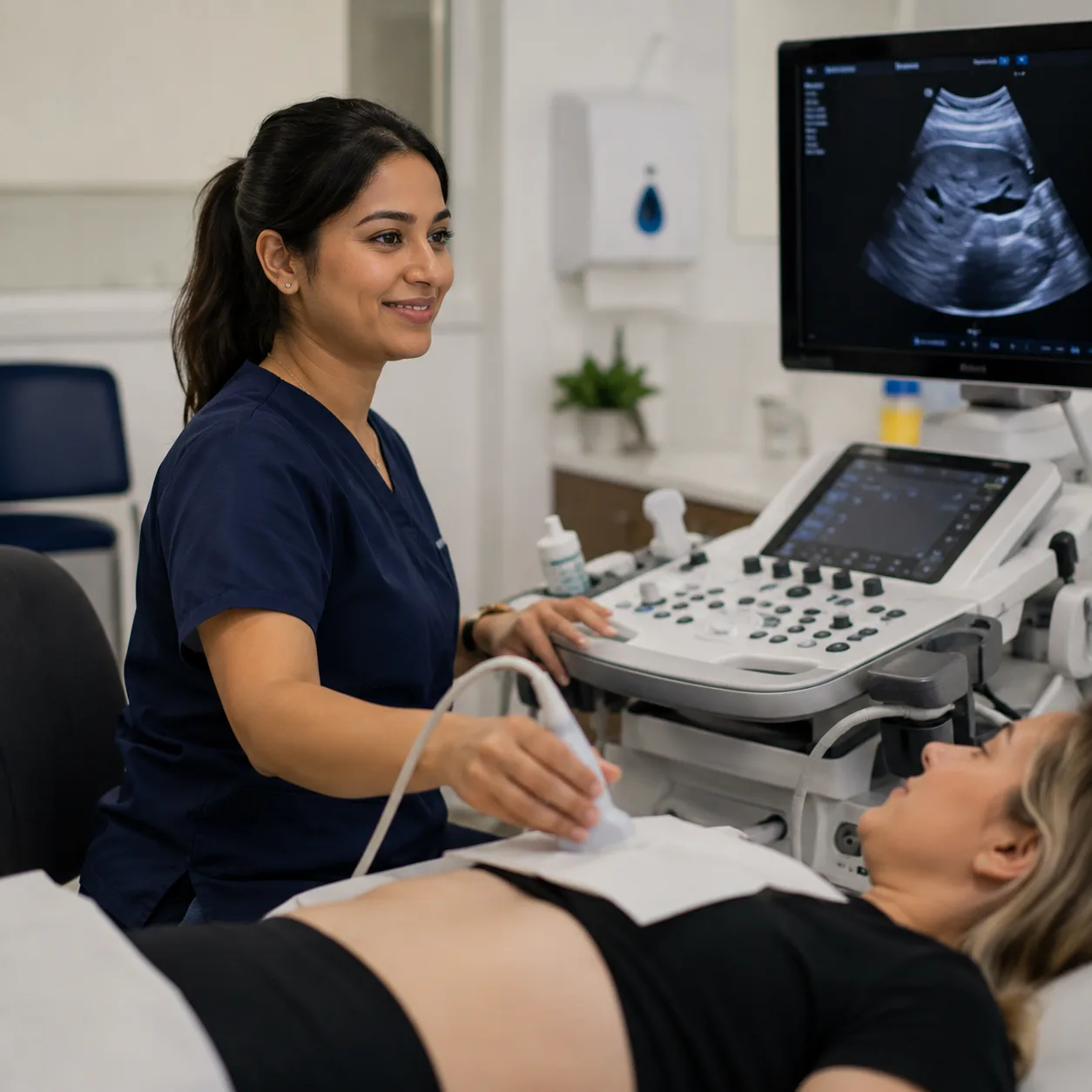
You scan autonomously, across a broad case mix.
Most sonographers here work independently across a wide range of studies, and many build a sub-speciality while keeping general scanning. General sonography covers abdominal, obstetric, gynaecological, musculoskeletal, vascular and small-parts work — the backbone of private imaging.
Cardiac sonography is a distinct area — transthoracic, transoesophageal and stress echo — and usually needs a recognised echo qualification. Senior, lead and education roles offer a career ladder beyond the scanning list.
How accreditation works →
Only one of the two countries regulates the title.
New Zealand registers sonographers as a health profession with a protected scope. Australia does not regulate the title: professional recognition and an accreditation register govern who can scan and whose scans attract funding.
That one difference shapes the paperwork before you arrive, who can employ you, and how much say you have over your own practice once you are there. Registration is a separate process in each country — never assume one follows from the other.
Australia or New Zealand? →
The essentials, in five minutes
Seven questions people ask before they decide. Open the ones that matter to you.
Can I work there?Yes, through accreditation
Sonographers don’t follow the Ahpra route. Two steps, in order: ASMIRT assesses your overseas qualification and experience and issues your Certificate of Recognition in Ultrasound, then the ASAR accredits you to practise and to scan under Medicare. ASAR also needs you to be a citizen, a permanent resident, or to hold a valid Australian working visa.
How accreditation works →What could I earn?Among the best-paid in imaging
Public pay comes from each state’s own enterprise agreement, so the band moves when you cross a border. The private market is very large, carries high scan volumes and is usually where pay climbs fastest for experienced sonographers. Superannuation sits on top of base pay.
How pay is set →Where are the jobs?Strong demand, metro and regional
Hospital departments and one of the world’s largest private imaging markets, across many parts of the country rather than just the capitals. Regional services often move fastest.
See current roles →What will the work be like?Autonomous, broad case mix
Autonomous scanning across a broad case mix, with room to build a sub-speciality alongside general work. Cardiac sonography is a separate area with its own qualification.
The work itself →Can I bring my family?Yes, most people do
Partners and children can usually be included on your visa, and partners can usually work. Schools, childcare, Medicare and the family logistics are explained once, properly, in the family guide.
Family moves, explained →What will moving cost?Budget for real fees
The ASMIRT qualification assessment, ASAR accreditation and its annual renewal, visa fees for everyone moving, flights and shipping. Some employers contribute to relocation, some don’t — we get whatever is offered in writing.
The move, costed →How long could this take?Several months, in a set order
ASMIRT first, then ASAR: starting the second before the first is finished wastes weeks. ASAR accreditation also depends on your visa status, so the immigration and accreditation tracks have to be sequenced rather than simply run side by side. Evidence of recent scanning practice is the usual bottleneck.
The journey, sequenced →Roles we're recruiting for now
If none is quite right, register your interest and we'll be in touch when something fits.
The detail, when you want it
Registration, pay, the work itself and life outside it. Everything is here, one section at a time.
Getting accreditedHow you get accredited
Reviewed July 2026 · checked against the ASAR’s current published guidance
Simpler than it sounds: one organisation assesses your qualification, a second accredits you to practise.
ASMIRT
Assesses your overseas qualification and experience, and issues your Certificate of Recognition in Ultrasound.
ASAR
Your ASMIRT recognition supports your accreditation with the Australian Sonographer Accreditation Registry.
Ready to work
An Accredited Medical Sonographer, able to scan under Medicare.
What about Ahpra?
Sonographers don't follow the Ahpra registration pathway — the route is ASMIRT → ASAR. Ahpra (through the MRPBA) registers professions like diagnostic radiography and radiation therapy.
What you'll need to apply
ASMIRT — the Australian Society of Medical Imaging and Radiation Therapy — is the gateway; get that assessment moving first. You'll need:
- Your ultrasound qualification and full academic transcript
- Evidence of recent clinical scanning practice (recency matters)
- Professional references confirming roles, dates and modalities
- English-language evidence, where your visa or employer requires it
What ASAR expects of you
Alongside your ASMIRT certificate, you'll need to be an Australian or New Zealand citizen, a permanent resident, or hold a valid Australian working visa. If you're accredited on a working visa, each year's renewal depends on showing ASAR a valid visa for that year.
There's also a recency rule: if your ASMIRT certificate is more than three years old, ASAR generally expects evidence of about a year part-time or six months full-time in clinical ultrasound within the last three years. If you can't meet that, its return-to-practice policy applies instead.
Your accreditation resources
Our full guide walks through accreditation and both visa routes. If you'd rather just ask, we're happy to talk it through.
Pay & benefitsHow pay is set
Sonographers are among the best-paid imaging professionals here. Public pay is set state by state; the private market is where it climbs fastest.
State enterprise agreements
Each state's public-health agreement sets base pay and progression. We confirm the current band, verified against the agreement, for every role.
Large & competitive
A very large private imaging sector with high scan volumes — often the strongest earning potential for experienced sonographers.
Loadings, leave & super
Overtime, on-call and after-hours loadings, four weeks' annual leave as standard, and compulsory superannuation on top of pay.
We don't print a figure against a named role until it's confirmed with the employer — and whatever applies to relocation, we get in writing before you decide. Ask us for current pay.
More detailThe limits we're upfront about
What we will and won't commit to, said plainly.

Sonographers are among the most sought-after health professionals in Australia, so the question isn't simply whether you'll find work, but what kind of working life you want.
Regional employers can sometimes offer more flexibility around relocation and start dates than larger metro services. If you're considering regional Australia, it's worth looking beyond what's written in the advert.
Tell me what matters to you — speciality, location, lifestyle or more time at the weekend — and I'll look for the role that fits.
SophieFounder, Ethicare Resourcing
What we can’t promise
Three things we won’t guarantee, and what we do instead.
Timelines that aren’t ours to give
Qualification assessment sits with ASMIRT, accreditation with ASAR, and visas with the Department of Home Affairs. We’ll give you the likely range, keep your file complete and moving, and chase what can be chased — but we won’t quote a faster number just to win you over.
A specific job in a specific suburb
Vacancies move. If your heart is set on one workplace in one corner of one city, we’ll tell you plainly how long that wait could be — before you resign anything, not after.
That the move is right for you
Some moves shouldn’t happen. If the accreditation route, the pay maths or the family logistics don’t stack up, we’ll say so plainly.
Frequently asked
Will my overseas qualification be recognised?
That depends entirely on where and what you studied. ASMIRT assesses your qualification against the Australian standard as it stood when you qualified, with three possible outcomes: unconditional recognition, conditional — further evidence or additional clinical experience first — or not recognised. Unlike radiography, there's no standard exam you can simply sit if it falls short; the ask may be further evidence, more clinical experience or further education. Send us your details before you commit to anything and we'll tell you plainly which is likely.
What about the visa and skills assessment?
Yes — ASAR won't accredit you without it, whichever visa you're on. It does double duty though: for a skilled-migration visa (189, 190 or 491) the same certificate supports the skills assessment Home Affairs requires. Most of the sonographers we place move on an employer-sponsored 482 instead, where the employer sponsors the role and you work toward accreditation alongside. Either way, we support the candidates we place through the visa process.
How does it compare to New Zealand?
Australia's market is much larger; New Zealand has an acute shortage and unusually strong public pay. We set the two side by side above, the full country comparison is in Australia or New Zealand?, and the money side in Where will your salary go further?.
What do you want your scan list to look like?
Moving countries is a big decision, and you won't be making it on your own. Tell us where you trained and what you're weighing up.