

Occupational therapy, with room to make a difference.
The funding model changes everything.
New Zealand’s ACC system can fund assessment, rehabilitation, equipment and home modifications after injury — creating a different environment for helping people regain independence.
The system here backs rehabilitation.
For occupational therapists, New Zealand offers something rare: manageable caseloads, autonomy, and ACC-model funding that lets you focus on helping people recover and return to life.
- Manageable, person-centred caseloads
- Clinical autonomy
- A system built around rehabilitation
Add shorter commutes and the outdoors close by, and the move tends to give back time and headspace as well as a different way of working.
Where you could live →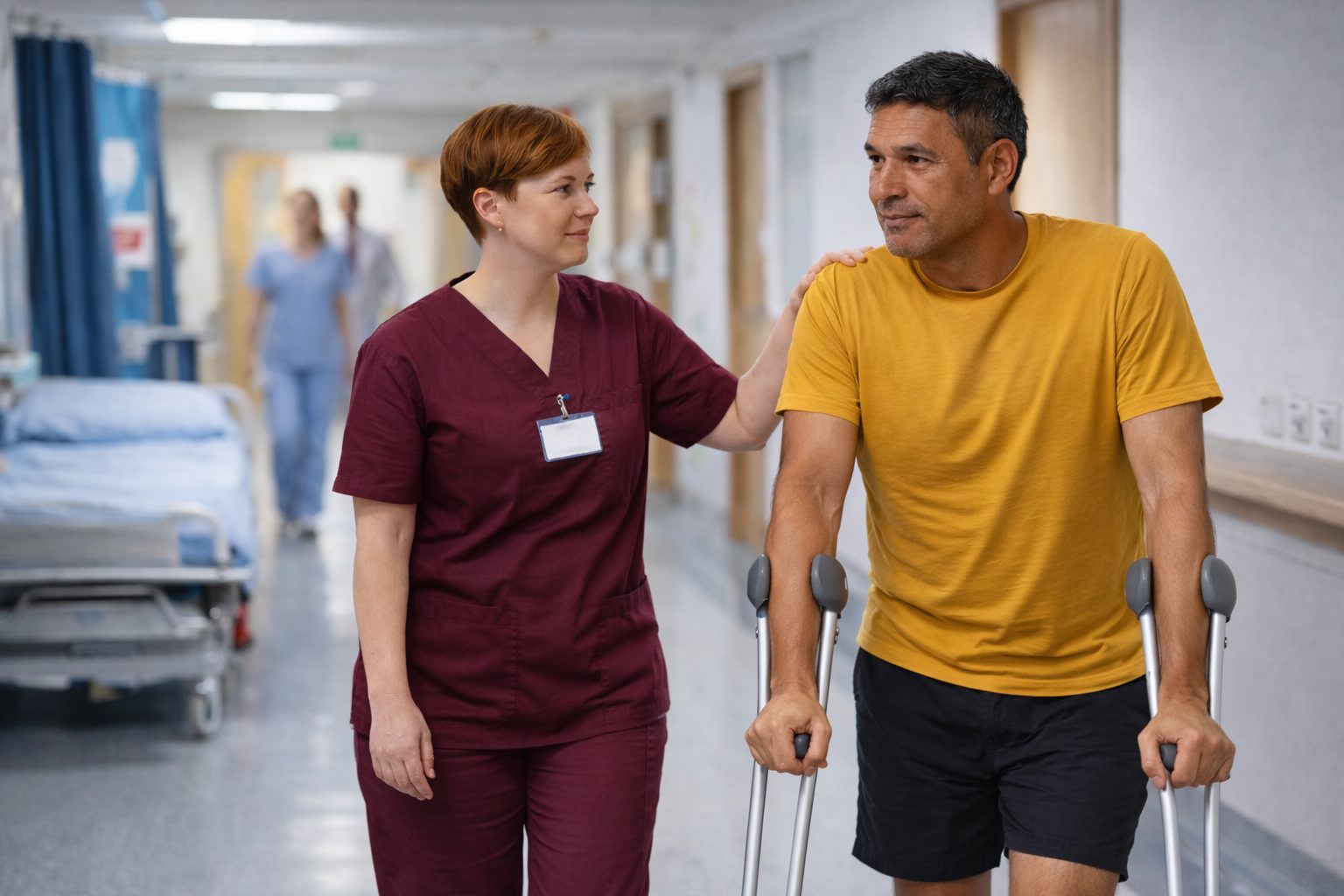
The funding follows the person, so the plan can actually happen.
Occupational therapy travels well as a clinical skill. What is different here is who pays for the plan, and where the work happens. New Zealand’s no-fault accident scheme pays for OT assessment and intervention directly — equipment, home modifications, vocational rehabilitation, return-to-work planning — for anyone injured here, however it happened. Funding decisions move faster, injury-related work makes up a bigger share of most caseloads, and a great deal of OT happens outside hospital walls because someone is paying for it to.
Community and home-based practice is the centre of the profession here, not the overflow. You will spend real time in people’s houses, workplaces and schools, usually carrying your own caseload with the authority to make the call. That is more autonomy than many OTs arrive with. It also means more driving, more lone working, and more of your clinical reasoning happening in someone’s kitchen rather than in a team room.
Assessment is whānau-centred, and that is a clinical difference. You formulate around a household, not only an individual, and for most OTs arriving from overseas that is the new part of the job. Recommending what someone needs and watching it arrive is the part OTs tell us they had stopped expecting.
The scope in full →
A broad scope, with the decision far more often yours.
New Zealand OTs work across physical and mental health, rehabilitation, community, paediatric and ACC-funded settings, usually with more independence than in a heavily tiered service. You hold your own caseload, own the outcomes, and make independent clinical decisions about assessment, intervention and discharge. Most OTs build depth in an area over time while keeping a generalist base underneath it.
Prescribing equipment and recommending housing modifications is core work rather than a referral you pass on, funded through ACC or through Ministry of Health pathways depending on the person. There is still assessment and accountability, but the decision is far more often yours.
Return-to-work planning, workplace ergonomic assessment and graduated return are routine ACC-funded work rather than a specialist niche. Sensory-based practice is well embedded in mental health and paediatrics, and if sensory regulation is an interest there is an active community of practice here. Hand therapy, neuro rehabilitation, paediatrics, mental health and older-person services all have established specialist routes. Tell us the work you want and we will tell you where it exists.
Getting registered →
The essentials, in five minutes
Seven questions people ask before they decide. Open the ones that matter to you.
Can I work there?Yes, with OTBNZ registration
You register with the Occupational Therapy Board of New Zealand, which assesses your qualification, experience and competency against New Zealand standards, and then hold an Annual Practising Certificate. Well-trodden for internationally trained OTs, whether you trained in the UK, South Africa, the UAE or elsewhere. The Board decides, not us.
Check my pathway →What could I earn?Around NZ$79,000–$119,000
Indicative, on the APEX occupational therapy scale. Occupational therapy is covered district by district rather than by one national agreement, so we confirm the scale for the service you are joining and tell you where you would land on it. Private and ACC-funded work sits outside that and varies.
How pay and pathways work →Where are the jobs?Strong demand, hospital to community
High demand across community, rehabilitation and mental-health services, plus hospital teams, ACC-funded work and private practice. Broad enough that location is usually your choice rather than the vacancy’s.
See current roles →What will the work be like?ACC pays for rehabilitation directly
The clinical skill travels; who pays for the plan does not. New Zealand’s no-fault accident scheme funds OT assessment and intervention directly — equipment, home modifications, vocational rehabilitation, return-to-work planning — so funding decisions move faster than you are used to, and equipment and home-modification work carries more weight. You hold your own caseload and own the discharge decision.
The work itself →Can I bring my family?Yes, most people do
Partners and children can usually join you on visas linked to yours, and partners can usually work. Schools, childcare and the family logistics are explained once, properly, in the family guide.
Family moves, explained →What will moving cost?Budget for real fees
Board registration and your first practising certificate, qualification verification, police clearance, visa fees for everyone moving, flights and shipping. Some employers contribute to relocation, some don’t — we get whatever is offered in writing.
The move, costed →How long could this take?Usually several months
Registration and the visa run largely in parallel, and document verification is usually the slow part — start collecting evidence of recent practice early. First conversation to first shift realistically spans several months.
The journey, sequenced →Current opportunities
Roles we're recruiting for right now. If none is quite right, register your interest and we'll be in touch when something fits.
The detail, when you want it
Registration, pay and life outside work. Everything is here, one section at a time.
Getting registeredRegistration overview
Reviewed July 2026 · checked against the Occupational Therapy Board of New Zealand’s current published guidance
To practise in New Zealand you'll register with the Occupational Therapy Board of New Zealand (OTBNZ). For most internationally trained OTs the process is well-trodden, and we’ll help you through it.
The Board assesses your qualification, experience and competency against New Zealand standards. As part of the process you'll typically need:
- Verification of your qualification
- Evidence of recent clinical practice
- A police / criminal-history clearance
- Confirmation of English-language proficiency, if required
Te Tiriti o Waitangi obligations and Māori models of health — Te Whare Tapa Whā most commonly — sit inside the competencies the Board assesses you against rather than alongside them as training. For most OTs arriving from overseas this is the new part of the job, and it changes the plan, not only the paperwork.
Once registered, you’ll hold an Annual Practising Certificate (APC). We support you from pathway to placement.
Registration pathways
Your route depends on where you trained and how closely your experience aligns with New Zealand standards.
Internationally qualified pathway
The common route for OTs trained overseas, assessed against New Zealand standards, sometimes with supervised practice.
Comparable-country pathway
A more streamlined route for those from recognised comparable systems.
Your registration resources, all on one page
Read the Board's own registration guide, work through the checklist, then go straight to the people who register you.
Prefer a download? Registration guide · Checklist
Registration checklist
What to gather before you apply to the OTBNZ:
- Certified copies of your qualifications
- Evidence of recent, relevant clinical practice
- A certificate of good standing from every authority you’ve registered with
- A police / criminal-history check
- Proof of identity, plus any name-change documents
- English-language evidence (IELTS or OET), if required
- One personal and one professional referee
- Your application fee, ready at submission
Advice & notes
Start early
Gathering documents before you apply is the single best way to avoid delays. Missing paperwork is the most common hold-up.
Mind the dates
Certificates of good standing and certified copies have a short validity window, so time them so they’re still current when you submit.
Then your visa
Apply for your visa once you have a job offer. We’ll guide the order so nothing happens out of sequence.
You’re not on your own
We’ll review your documents with you before you submit, and stay alongside you through every step.
The difference that shapes the workThe ACC model, and why it matters
New Zealand’s Accident Compensation Corporation (ACC) funds injury-related care, creating a more direct, rehabilitation-focused way of working with fewer barriers between assessment and treatment.
A typical weekWhat your day-to-day can look like
Your role varies by setting, but most OTs enjoy a varied caseload and a high degree of autonomy.
- Assessing and supporting a varied caseload
- Developing person-centred goals and plans
- Supporting clients through rehabilitation and recovery
- Collaborating with multidisciplinary teams
- Building long-term relationships in the community

OTs often aren’t sure how their experience will translate. In reality the transition is usually smooth: the standard of practice aligns closely, and ACC makes the rehab focus even clearer.
There can be a short adjustment while you get familiar with ACC and a new system, but it’s usually brief, and OTs tend to move quickly into highly autonomous work.
SophieFounder, Ethicare Resourcing
What we can’t promise
Three things we won’t guarantee, and what we do instead.
Timelines that aren’t ours to give
Registration sits with the Occupational Therapy Board and visas with Immigration New Zealand. We’ll give you the likely range, keep your file complete and moving, and chase what can be chased — but we won’t quote a faster number just to win you over.
A specific job in a specific suburb
Vacancies move. If your heart is set on one workplace in one corner of one city, we’ll tell you plainly how long that wait could be — before you resign anything, not after.
That the move is right for you
Some moves shouldn’t happen. If the scope, the pay maths or the family logistics don’t stack up, we’ll say so plainly.
Frequently asked
Do I need to be an ACC-approved provider?
It depends entirely on how you are working. If you are employed by a public service or an established provider, their contracting with ACC covers the work and you do not arrange anything yourself — you will simply notice that funding for equipment and rehab arrives from a different place than you are used to.
If you are planning to work privately and invoice ACC directly, that means meeting their provider requirements, so check them before you set anything up. Tell us which you are considering and we will explain what applies.
Does my UK or South African experience count?
Yes. The Board assesses your qualification, your recent practice and your competency against New Zealand standards, and training from the UK, South Africa, Ireland, Australia and comparable systems is well recognised. Most internationally qualified OTs come through this route without difficulty.
The adjustment when you arrive is rarely clinical. It is the funding system, the amount of community work, and whānau-centred assessment — not your ability to do the job.
What does Te Tiriti practice mean day to day?
Practical things, mostly. Involving whānau in assessment and planning as a matter of course rather than on request. Working with Te Whare Tapa Whā as a model that includes spiritual and family wellbeing alongside the physical. Getting names and pronunciation right. Asking about a household rather than assuming it.
Employers provide induction and ongoing support, and nobody expects you to arrive fluent. They do expect you to arrive willing, and it will come up at interview.
Public or private — which gives the better caseload?
Different rather than better. Public gives you structured teams, supervision on tap, breadth of presentation and a clear progression path. ACC-funded private practice gives you more autonomy, more focused rehabilitation work, faster access to funding, and often more control over your diary.
A lot of OTs here do some of both over time, and moving between them is normal rather than a career reset.
How does equipment and home modification funding work?
Through two main routes: ACC for anything injury-related, and Ministry of Health pathways for need arising from disability or illness. Both are assessment-driven, and as the assessing OT you carry considerably more of the decision than in a panel-based system.
It is not unlimited and it is not instant. But the gap between what you recommend and what your client receives is much smaller than most OTs are used to.
Is there specialist work — hand therapy, sensory, neuro?
Yes, all three, with established routes into them. Hand therapy has its own strong professional community. Sensory practice is well embedded in mental health and paediatrics. Neuro rehabilitation runs across inpatient and community services.
Specialisation here tends to be built on a generalist base rather than entered straight from training, so if you are already specialised, tell us early — those roles are fewer and worth timing properly.
What would you do with a caseload you can do properly?
Relocating to a new country can feel overwhelming at times, and you won't be doing it on your own. Find your registration pathway in two minutes, then send us your CV and we’ll take it from there.