
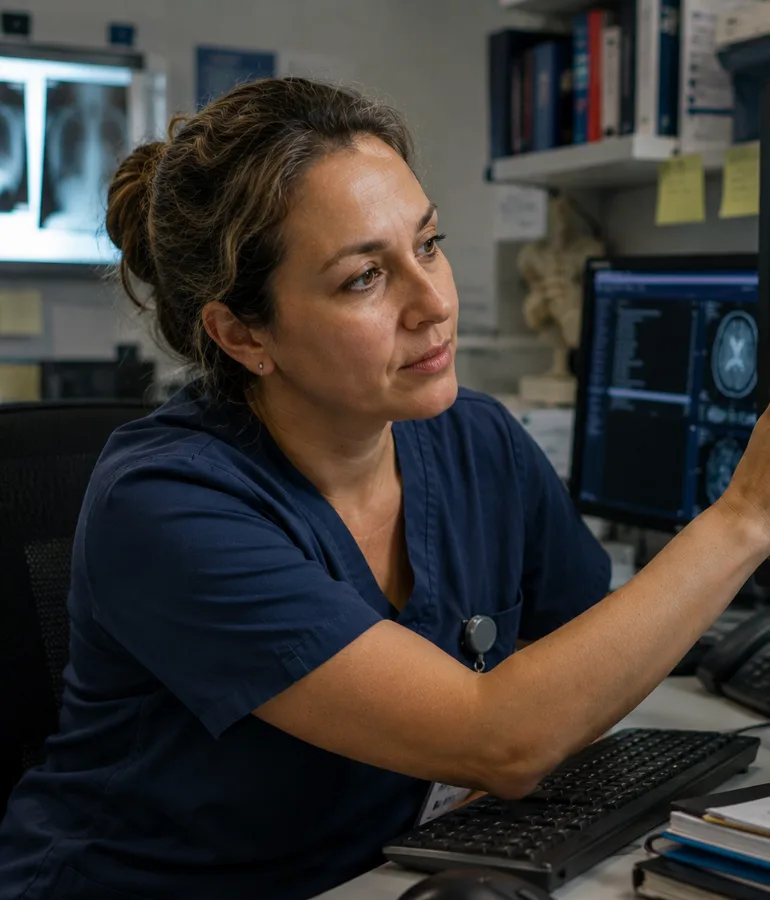
Exceptional radiology. An exceptional life.
One assessment shapes the route ahead.
Your specialist comparability assessment determines the steps between your current practice and working independently in Australia.
Radiologists are wanted here, in both halves of the system.
Consultant radiologists are in strong, sustained demand across Australia — in public hospital services and one of the world's largest private radiology markets, metro and regional. The case mix is broad and sub-speciality work is well supported.
- Strong demand — public and a very large private market
- Sub-speciality scope and modern RIS/PACS
- A specialist pathway built for internationally trained consultants
Specialists move here from across the world — the UK, South Africa, Ireland, the UAE and beyond — and many tell us the move gives back real time without compromising the work. The lifestyle around the role is, for many, the real draw.
Where you could live →
Keep the general list, or go deep in one area.
Australian radiology supports broad general practice and focused sub-speciality work, in public and private settings. You report CT, MRI, ultrasound and plain film, with sub-speciality scope in interventional, breast, neuro, musculoskeletal, body, cardiac and paediatric imaging.
Many consultants split time between public MDT-based work and private reporting, and modern RIS/PACS, teleradiology and structured reporting are the norm. Academic, leadership and training roles are well supported, and the scale of the system means there are real posts in them.
How pay works, public and private →
One college, two quite different working lives.
For radiologists both countries are strong options: sophisticated imaging services, real demand for experienced specialists, and a shared training tradition through RANZCR. Australia has a much larger radiology market, significant private-sector opportunity and potentially very high earning potential.
New Zealand has a smaller, more connected system with interesting public and private roles, and suits radiologists looking for a long-term change rather than a different job. Your subspecialty, and how you feel about public against private practice, matter more than the country name. Registration is a separate process in each country — never assume one follows from the other.
Australia or New Zealand? →
The essentials, in five minutes
Seven questions people ask before they decide. Open the ones that matter to you.
Can I work there?Yes, via the specialist pathway
You hold specialist registration with the Medical Board of Australia through Ahpra. RANZCR assesses how comparable your training is to an Australian-trained radiologist and the Board decides on that advice. The finding — substantially, partially or not comparable — is what shapes whether you begin in a supervised role before full specialist recognition.
How registration works →What could I earn?One of the world’s largest private markets
Public consultant appointments are salaried or sessional under each state’s enterprise agreement, with set progression. Private reporting income is market-based and often strongest with CT, MRI and sub-speciality work — and many consultants split the week between the two. We confirm the figure per role rather than printing one.
How pay is set →Where are the jobs?Sustained consultant demand
Public hospital radiology services and a very deep private market, in the capitals and beyond. Mixed public/private appointments are common, so the shape of the week is often as negotiable as the location.
See current roles →What will the work be like?The full range of modalities
CT, MRI, ultrasound, interventional, breast, neuro, MSK, body and paediatric — diagnostic and interventional, general and sub-specialised. How much of that you carry depends far more on the size and sector of the service than on the job title.
The work itself →Can I bring my family?Yes, most people do
Partners and children can usually be included on your visa, and partners can usually work. Schools, childcare, Medicare and the family logistics are explained once, properly, in the family guide.
Family moves, explained →What will moving cost?Budget for real fees
Ahpra registration and annual renewal, the RANZCR specialist assessment, document verification and certificates of good standing, visa fees for everyone moving, flights and shipping. Some employers contribute to relocation, some don’t — we get whatever applies confirmed in writing.
The move, costed →How long could this take?Your comparability finding decides it
Substantially comparable is the most direct route and usually leads to specialist registration after a short period of supervision. A partially comparable finding adds requirements and months. Assemble the logbook, case evidence and structured CV properly — that is what the assessment turns on.
The journey, sequenced →Current opportunities
Roles we're recruiting for right now. If none is quite right, register your interest and we'll be in touch when something fits.
The detail, when you want it
Registration and pay, set out in full. Open the section you need.
Getting registeredSpecialist registration overview
Reviewed July 2026 · checked against the Medical Board of Australia’s current published guidance
You hold specialist registration with the Medical Board of Australia, through Ahpra. For an internationally trained specialist that runs through the specialist pathway: RANZCR assesses how comparable your training is to an Australian-trained radiologist, and the Board makes the registration decision on that advice.
The RANZCR assessment finds you substantially comparable, partially comparable or not comparable — which shapes whether you start in a supervised role on provisional (or limited) registration before full specialist recognition. If you hold the Canadian Royal College certificate in diagnostic radiology, the Expedited Specialist pathway applies instead. You'll typically be assembling:
- Your specialist medical qualifications and training record
- Detailed logbook / case evidence and a structured CV
- Registration history and a current Certificate of Good Standing
- English-language evidence, where the standard requires it
After your comparability outcome
What the RANZCR finding means for how you begin practising:
The most direct route — leads to specialist registration, usually after a short period of supervised practice (peer review) before full specialist recognition.
A longer period of supervised practice and/or some top-up training or exams, after which you progress to full specialist recognition.
The specialist pathway isn't the right fit on the evidence provided — we'll set out the alternatives.
Where required, you practise under a College-approved supervisor while completing requirements — usually easy to arrange in a market this short of radiologists.
The Medical Board of Australia, through Ahpra, makes the registration decision and grants specialist registration once requirements are met.
Pathways into practice
Most internationally trained radiologists come through the specialist pathway, assessed by RANZCR.
RANZCR comparability assessment
RANZCR reviews your qualifications and experience against the Australian standard. A “substantially comparable” outcome leads most directly to specialist registration; “partially comparable” usually means a period of supervised practice and/or top-up requirements first.
Registration & oversight
The Medical Board grants registration on the College's advice, often beginning with a defined period of supervised practice. We help you line up a role and supervision so the clinical and registration timelines move together.
Your registration resources
The full guide covers which route is yours, the RANZCR assessment and its three outcomes, the Expedited Specialist pathway, supervised practice and section 19AB Medicare, with a checklist that remembers what you have ticked.
Pay & benefitsStrong demand, strong pay
Australia has one of the world’s largest private radiology markets, and consultant pay reflects it. Public posts sit on state agreements, private reporting on the market — we’ll confirm the figure for the actual role before you commit.
Public consultant contracts
Salaried (or sessional) public consultant appointments under state enterprise agreements, with set progression. We confirm the current arrangement, verified against the agreement, per role.
Private reporting
One of the world's largest private radiology markets — reporting-based income, often strongest with CT/MRI and sub-speciality work.
Mixed public/private appointments
Many consultants split the week between a public appointment and private reporting — a common, flexible model here.
Sessional opportunities
Sessional and teleradiology arrangements let you shape your hours and workload around the life you want.
Varies by employer
Varies by employer and role — some contribute towards the move, others don’t. We ask directly and get whatever applies confirmed in writing before you decide.
Skilled & sponsored
Employer-sponsored (482) and skilled routes, with partner work rights and schooling for children. We support the candidates we place through the visa process.
Figures are intentionally not stated here until they're verified for your specific role against the relevant agreement or award. Ask us for current pay for where you'd be working.

For consultant radiologists, the draw is that exceptional earning potential and an exceptional lifestyle can exist together here — it's one of the things that makes Australia different.
The pathway runs through RANZCR's comparability assessment and Medical Board specialist registration. It's well-trodden for UK, Irish, South African and other internationally trained specialists — the key is getting the assessment, a role and supervision lined up so the timelines move together, which is exactly where we help.
Tell me what you want — a sub-speciality focus, a public/private mix, a regional lifestyle role with more time at the weekend — and I'll work to find a post that fits it.
SophieFounder, Ethicare Resourcing
What we can’t promise
Three things we won’t guarantee, and what we do instead.
Timelines that aren’t ours to give
Registration sits with the Medical Board of Australia (Ahpra) and visas with the Department of Home Affairs. We’ll give you the likely range, keep your file complete and moving, and chase what can be chased — but we won’t quote a faster number just to win you over.
A specific job in a specific suburb
Vacancies move. If your heart is set on one workplace in one corner of one city, we’ll tell you plainly how long that wait could be — before you resign anything, not after.
That the move is right for you
Some moves shouldn’t happen. If the scope, the pay maths or the family logistics don’t stack up, we’ll say so plainly.
Frequently asked
How does specialist registration work?
You hold specialist registration with the Medical Board of Australia, through Ahpra. For internationally trained radiologists that runs via the specialist pathway, where RANZCR assesses how comparable your training and experience are to an Australian-trained radiologist, and the Board registers you on that advice.
What does the RANZCR assessment look at?
Your qualifications, training and clinical experience — resulting in a finding of substantially, partially or not comparable. “Substantially comparable” is the most direct route; “partially comparable” usually means a period of supervised practice and/or top-up requirements before full specialist recognition.
Will I start under supervision?
Often, yes — many specialists begin in a supervised role on provisional (or limited) registration while completing any College requirements, then move to full specialist recognition. In a market this short of radiologists, suitable supervised posts are usually easy to arrange.
What about the visa?
Most consultants relocate on an employer-sponsored visa, with skilled routes also available. The College assessment and the visa are separate workstreams; we help line them up so they don't hold each other up.
How long does the RANZCR assessment usually take?
It varies with your training, your paperwork and the College's current workload, so we avoid firm promises. The biggest thing in your control is a complete, well-evidenced application — we help you assemble it so nothing stalls, and we keep the role and visa moving in parallel so the timelines don't hold each other up.
What does “substantially comparable” mean?
It's RANZCR's finding that your training and experience are close enough to an Australian-trained radiologist's to lead, most directly, to specialist registration — usually after a short period of supervised practice (peer review) before full specialist recognition.
Can I work privately?
Yes. Australia has one of the world's largest private radiology markets, and many consultants work privately, in public services, or in a mix of both. Any conditions on your registration while you complete College requirements shape the timing — we'll set that out clearly for your situation.
Will my fellowship be recognised?
That's exactly what the RANZCR comparability assessment determines. Fellowships from comparable training systems are often found substantially comparable; we'll give you a clear read on your likely outcome before you commit time and money.
Can I relocate with my family?
Yes. The common visa routes carry partner work rights and schooling for children, and relocation support is frequently part of the package. We help line up the move for the whole family, not just the role.
Where would you like to be reporting from next year?
Relocating to a new country can feel overwhelming at times — and you won't be doing it on your own. Find your registration pathway in two minutes, then send us your CV and we’ll take it from there.